
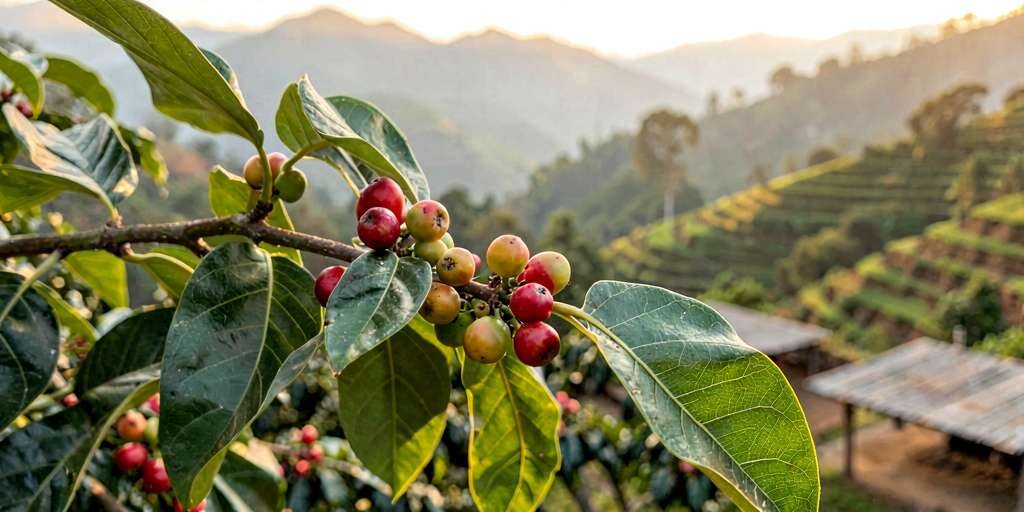
The first time I tried a coffee labeled as Sidra from Ecuador, I found myself staring at the cup searching for words. It was floral, fresh, with a bright acidity that reminded me of bergamot and lemon, with a silky body and a sweetness that lingered for a long time. I thought it was the processing, but the barista explained that it was the variety: Sidra, a 100% landrace coffee of Ethiopian origin adapted to Ecuadorian farms, which has reached the world barista championships thanks to Ecuadorian baristas. I researched everything about this variety, and what I found is fascinating. Let’s begin!
Coffee in Ecuador: context and evolution
Coffee has found a special place in Ecuadorian culture, where its history is intertwined with the lives of rural communities. Over the years, it has evolved from being a local crop to becoming a product with international reach.
Historical development of Ecuadorian coffee growing
Coffee growing in Ecuador has deep roots, dating back to the 18th century. Initially, it was cultivated mainly for domestic consumption. Over time, production expanded, and coffee became one of the country’s main exports.
Challenges and opportunities for national production
Throughout its development, the coffee sector has faced significant challenges, such as the emergence of pests and changes in the global market. However, there are also opportunities for Ecuadorian producers, who seek to diversify their varieties and improve quality. The impact of globalization has increased international competition, but also the demand for unique, high-quality coffees.
Specialty coffee: growth and potential in the country
In recent years, Ecuador has seen a boom in specialty coffee production, attracting the attention of enthusiasts and experts. This type of coffee, focused on quality and origin, positions the country as a competitor in the global market, with unique varieties grown at suitable altitudes and a distinctive sensory profile that reflects the country’s biodiversity.
Origin and characteristics of the Sidra variety
Genetic roots and selection process
Influence of Ethiopian germplasm
The origin of Sidra goes back to its Ethiopian genetic roots. This variety is 100% landrace, which implies that it has specific wild characteristics that come from Ethiopia. The connection with coffee’s center of origin gives Sidra a rich and diverse genetic base, fundamental to its cup profile.
Phenotypic adaptation to Ecuadorian farms
Phenotypic adaptation has been key to its development. On Ecuadorian farms, Sidra coffee plantations have shown changes that allow this variety to flourish at specific altitudes, thus achieving superior flavor and distinctive character.
Agronomic traits and plant resistance
Plant stature and growth habits
With tall stature and long internodes, Sidra shows growth habits that are ideal for its maintenance. This aspect allows coffee plantations to develop properly at different altitudes.
Tolerance to pests and diseases
The variety shows moderate tolerance to various diseases, which is essential in sustainable cultivation. This resistance contributes to the viability of its production in an environment facing climatic challenges and pathogens.
Sensory profile and cup quality
Flavor notes and characteristic acidity
In cupping, Sidra is recognized for its bright acidity and flavor notes that include bergamot, lavender, honey, and tropical fruits. This combination makes it an exceptional coffee that delights the most demanding palates.
Evaluations according to the Specialty Coffee Association
Sidra coffees have obtained scores above 90 in Specialty Coffee Association evaluations. These high scores highlight their quality in the competitive world of specialty coffee.
Production and processes for Sidra coffee excellence
Sustainable agricultural practices in Ecuador
Production at optimal altitudes
Sidra coffee thrives at altitudes between 1,500 and 2,000 meters above sea level. These conditions allow the development of its unique and delicious sensory profile. The microclimate and soil at these elevations are ideal for growing this variety, offering sophisticated flavors and notable aromas.
Plantation management and fruit selection
Proper plantation management is crucial for Sidra production. Special attention is paid to the manual selection of the cherries, ensuring that only the best-developed ones are harvested. This practice reduces the risk of defects and improves coffee quality.
Post-harvest process and its impact on quality
Processing and fermentation methods
There are various processing techniques that can be applied to Sidra coffee. Washed processing and controlled fermentation help highlight its acidity and the fruity flavors that characterize it. Careful post-harvest handling is decisive in ensuring that Sidra’s sensory properties reach the cup intact.
Quality control and on-farm traceability
Quality control is carried out at every stage of the process, from harvest to delivery. Traceability is essential to guarantee consumers the quality and origin of Sidra coffee.
Role of Ecuadorian producers and coffee growers
Producers are key players in the Sidra coffee value chain. Their dedication and knowledge are essential for the development of this variety. In Ecuador, several coffee growers have been recognized for their exceptional work with Sidra, and they are exploring new techniques that can increase its productive potential and sustainability.
The Sidra variety and its presence in the international market
Exports and demand in neighboring producing countries
Sidra’s notoriety is not limited to Ecuador. Countries such as Colombia, Peru, and Panama have received Sidra coffee, appreciating its unique characteristics. This distribution has fostered trade relationships that benefit Ecuadorian producers. The international market has shown growing interest in high-quality coffees like Sidra, with a steady increase in demand and the value of this product.
Recognition in specialized shops and markets
The focus on quality has led Sidra to become a benchmark in specialty shops and cafés around the world. Baristas value Sidra’s complexity of flavors, and consumers appreciate its unique sensory profile. Interest in the variety has generated an increase in prices, giving Ecuadorian coffee growers greater economic benefit.
Ecuadorian baristas and Sidra in world championships
Relevance of the Ecuadorian barista in competitions
Jonathan Ramírez’s journey and contribution
Jonathan Ramírez, national champion in 2018, has been an ambassador for Ecuadorian coffee. His skill in preparing Sidra has captured the attention of judges and spectators, making him a benchmark of quality and technique on the international barista scene.
Martín Guayasamín and the outlook for 2026
Martín Guayasamín has prepared his participation in the world championship with Sidra as the star of his routine, seeking not only victory but also to reinforce the identity of Ecuadorian coffee at the international level.
The Sidra variety in the World Barista Championship
Sidra coffee has had a notable presence in several world championships. It has been the star of many presentations, which has allowed it to gain recognition from the public and specialists. Each participation contributes to greater interest in and demand for Sidra coffee outside Ecuador.
Challenges and protection of the origin of the Sidra variety
Threats and disputes over genetic authorship
Sidra’s legitimacy has been the subject of controversy: there are attempts to attribute the creation of Sidra to neighboring nations, which could affect the perception and value of this Ecuadorian coffee. Recognition of Ecuador as the country of origin is vital to protect the variety and promote the economic sustainability of coffee growing.
Strategies for the certification and registration of genetic material
The implementation of traceability systems makes it possible to track Sidra coffee production, ensuring that quality and Ecuadorian origin are maintained. Cooperation between coffee growers and regulatory bodies is essential to establish standards that highlight Sidra’s uniqueness in the market.
Future of Sidra coffee within Ecuador and in the world
The outlook for Sidra coffee is promising. As demand increases, growth in Sidra’s quality and production is expected, which translates into higher income for producers and broader recognition. Sidra coffee is gaining ground in specialty markets, where consumers seek quality and varietal singularity.
Frequently asked questions about the Sidra variety and its international impact
What is the genetic origin of the Sidra variety?
Sidra has genetic roots that come from Ethiopia and is considered 100% landrace. Its development in Ecuador stems from a Nestlé research project focused on obtaining disease-resistant, high-quality coffees. The wild characteristics of Ethiopian germplasm are responsible for its extraordinary cup profile.
What distinguishes Sidra coffee in terms of sensory profile?
Sidra coffee is known for its bright acidity and complexity of flavors. It presents notes of bergamot, lavender, honey, and tropical fruits, which has allowed it to receive scores above 90 in Specialty Coffee Association cuppings. Its prolonged sweetness and silky body distinguish it from other high-end varieties.
How do Ecuadorian baristas contribute to the recognition of Sidra?
Baristas such as Jonathan Ramírez and Martín Guayasamín have been fundamental in promoting Sidra coffee internationally. Their championship appearances have enhanced the perception of this variety among consumers and experts, turning Sidra into an ambassador for Ecuadorian specialty coffee.
What challenges does Ecuador face in protecting the Sidra variety?
The country faces the threat of the variety being appropriated by other nations. It is essential to establish a system for traceability and certification of the genetic material to ensure that the effort of Ecuadorian coffee growers is recognized worldwide and that Sidra’s origin remains protected.
What impact does Sidra have on the country’s coffee economy?
The growing demand for Sidra coffee has allowed Ecuadorian producers to obtain higher prices, invest in sustainable practices, and improve their processes. This contributes significantly to the country’s rural economy and positions Ecuador as a benchmark on the map of world specialty coffee.
Where can you drink specialty Sidra coffee in Spain?
Specialty Sidra coffee can be found in specialized coffee shops and in cafés that feature single-origin coffees. Many of these places are committed to quality and transparency regarding the coffee’s origin. It can also be purchased online through specialized roasters that work with high-end Latin American origins.
At Coffee Sapiens, we never stop researching to bring you the stories and the facts behind the most exceptional coffees in the world. The Sidra variety is one of those coffees that changes your perspective on what a cup can be. Thanks for being there, Coffee Lover!
{ “@context”: “https://schema.org”, “@type”: “FAQPage”, “mainEntity”: [ { “@type”: “Question”, “name”: “What is the genetic origin of the Sidra variety?”, “acceptedAnswer”: { “@type”: “Answer”, “text”: “Sidra has Ethiopian genetic roots and is considered 100% landrace. Its development in Ecuador stems from a Nestlé research project focused on obtaining disease-resistant, high-quality coffees.” } }, { “@type”: “Question”, “name”: “What distinguishes Sidra coffee in terms of sensory profile?”, “acceptedAnswer”: { “@type”: “Answer”, “text”: “Notes of bergamot, lavender, honey, and tropical fruits, with scores above 90 in SCA cuppings. Its prolonged sweetness and silky body distinguish it from other high-end varieties.” } }, { “@type”: “Question”, “name”: “How do Ecuadorian baristas contribute to the recognition of Sidra?”, “acceptedAnswer”: { “@type”: “Answer”, “text”: “Baristas such as Jonathan Ramírez and Martín Guayasamín have promoted Sidra in international championships, turning it into an ambassador for Ecuadorian specialty coffee.” } }, { “@type”: “Question”, “name”: “What challenges does Ecuador face in protecting the Sidra variety?”, “acceptedAnswer”: { “@type”: “Answer”, “text”: “The threat of the variety being appropriated by other nations. It is essential to establish traceability and certification systems for the genetic material to protect its Ecuadorian origin.” } }, { “@type”: “Question”, “name”: “What impact does Sidra have on the country’s coffee economy?”, “acceptedAnswer”: { “@type”: “Answer”, “text”: “Growing demand has allowed Ecuadorian producers to obtain higher prices and invest in sustainable practices, positioning Ecuador as a benchmark on the world specialty coffee map.” } }, { “@type”: “Question”, “name”: “Where can you drink specialty Sidra coffee in Spain?”, “acceptedAnswer”: { “@type”: “Answer”, “text”: “In specialized coffee shops and single-origin cafés, and online through specialized roasters that work with high-end Latin American origins.” } } ] }
Soy Javier Romero, especialista en Marketing Digital, Coffee Lover y redactor de Coffee Sapiens.
Bienvenidos a Coffee Sapiens. Somos un medio digital independiente dedicado a la divulgación, análisis y cultura del café.