
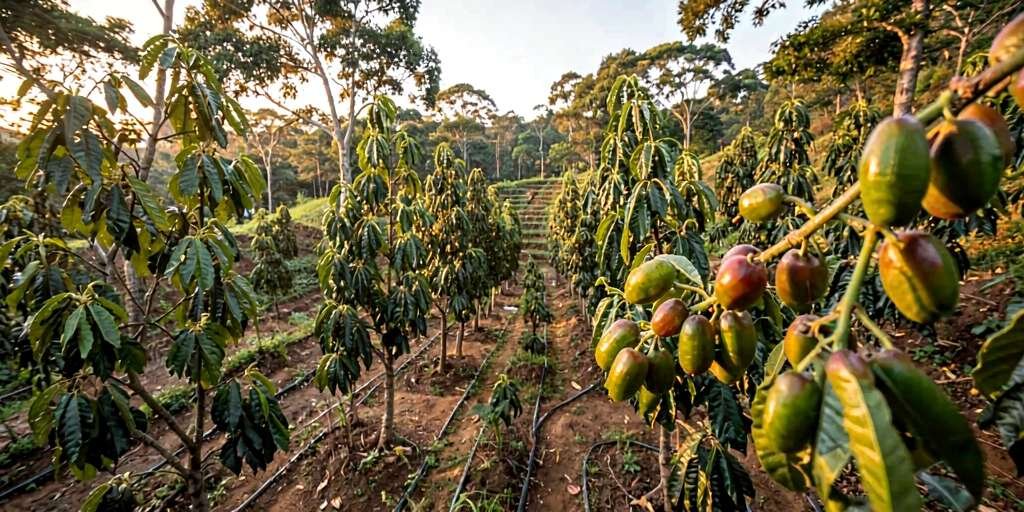
The Geisha coffee variety has always caught my attention, a coffee that stands out for its uniqueness and quality. Originally from Ethiopia, its cultivation has evolved in regions such as Panama and Costa Rica, where it has reached its full potential.
I have thoroughly researched how specific agronomic management is essential to ensure excellence in its production. After doing my homework, I wrote this article in which I will tell you about everything from its agronomic characteristics to the ideal growing conditions, all crucial to obtaining high-quality coffee. I hope you enjoy this great journey from Ethiopia to Panama and Costa Rica as much as I do. Let’s begin!
Origin and history of the Geisha variety
The Geisha coffee variety has a fascinating history that has led it to be recognized worldwide. Its origin lies in Ethiopia, and from there it has traveled a long way to become an icon of specialty coffee.
Geisha seeds and their introduction in Central America
The variety was collected by botanists in the forests of the Geisha district in Ethiopia around 1931. In 1936, these seeds were sent to Kenya and then to Tanzania, where it began to be recognized as Geisha. In the 1950s, the FAO sent seeds to Costa Rica, which were later introduced into Panama. This process marked the beginning of its cultivation in Central America and its popularization in the coffee market.
Panama as a benchmark for high-quality Geisha coffee
Panama has become a global benchmark for Geisha coffee, standing out for the production of extremely high-quality coffees. The climatic and soil conditions in regions such as Boquete and Volcán have allowed this variety to express itself in all its splendor. The meticulous attention that Panamanian producers devote to its cultivation has led this coffee to win international awards and revolutionize the gourmet coffee market.
Differences from other Arabica coffee varieties
Geisha stands out from other Arabica coffee varieties for several characteristics:
- Flavor and aroma: Geisha is known for its unique sensory profile, which includes citrus and floral notes, often considered more complex than those of other varieties.
- Plant structure: Geisha trees are usually tall, and their root system is less dense, which can influence their ability to absorb nutrients.
- Productivity: Geisha production is notably lower compared with other varieties such as Caturra, which represents a challenge for coffee growers when they consider cultivating it.
Agronomic characteristics of Geisha coffee
The Geisha variety presents agronomic characteristics that make it unique in coffee cultivation. From its physiology to its resistance to pests, every aspect is crucial to its development and quality.
Physiology and tall stature of the plant
Geisha coffee trees are characterized by their tall stature, reaching up to 1,800 meters above sea level. This vertical growth allows them to maximize light capture, an essential factor for their development. The leaves are long and elegant, which not only contributes to their visual appeal but also plays a role in efficient photosynthesis.
Root system and its impact on production
Geisha’s root system is less dense compared with other coffee varieties. This implies that it may suffer a greater risk of mortality if it is not subjected to proper management. Its limited ability to absorb nutrients can limit the amount of production, so it is vital to ensure a correct supply of nutrients and water.
Adaptation and resistance to leaf rust and other diseases
Geisha’s resistance to coffee leaf rust was one of its greatest attractions when it was introduced into commercial cultivation. However, over time, various strains of this fungus have evolved, which has led to a decrease in its effectiveness. Therefore, coffee growers must constantly evaluate the health of their plants.
Changes in resistance over time
Over the years, it has been observed that Geisha’s resistance to leaf rust is not static. New variants of the pathogen have emerged, affecting its performance and health.
Technical monitoring and preventive management
Implementing constant monitoring is essential to detect the presence of diseases. The use of soil analysis, together with the advice of agronomy technicians, can help foresee problems before they worsen.
Ideal conditions for Geisha cultivation
To obtain superior-quality Geisha coffee, it is essential to establish optimal growing conditions. These factors include altitude, climate, as well as careful site selection and preparation.
Optimal altitude and climate for organoleptic quality
Geisha coffee thrives best at altitudes above 1,500 meters above sea level. At this height, the climatic conditions allow slower bean development, which intensifies its flavor profile. A cool climate with temperatures ranging between 18 and 24 degrees Celsius is ideal.
Site selection and preparation
It is crucial to choose suitable land that favors Geisha’s growth and is capable of providing essential nutrients.
Soil analysis and recommended amendments
Before planting, carrying out a soil analysis is essential. This study will reveal nutrient availability, allowing coffee growers to apply the necessary amendments. The addition of organic matter, such as compost, can enrich the soil, while lime can correct acidity if necessary.
Drainage and nutritional composition
Proper drainage is essential, since Geisha does not tolerate waterlogging. Fertile soils must have good water-retention capacity, while at the same time allowing proper drainage.
Specific agronomic management for maximum quality
A careful approach to agronomic management can maximize the quality of Geisha coffee.
Planting density and layout
Choosing planting density is crucial. It is recommended to maintain a lower density compared with other coffee varieties. This allows air to circulate properly between the plants.
Influence on vegetative development and production
A strategic layout not only improves plant health, but also facilitates the manual harvesting of the cherries.
Fertilization adapted to the Geisha variety
Proper fertilization is essential to ensure that Geisha coffee trees express their full potential. A soil analysis should be carried out before planting in order to adjust nutrition to the plant’s specific needs.
Use of controlled-release fertilizers
It is advisable to apply controlled-release fertilizers that allow a constant supply of nutrients.
Integration of organic fertilizers for the soil
The incorporation of organic fertilizers helps improve soil quality, promoting root development and, consequently, production.
Efficient and controlled irrigation
Proper irrigation is essential, especially under drought conditions.
Recommended application in dry periods
During critical periods, it will be necessary to apply irrigation efficiently to ensure that the plants have adequate moisture.
Advantages of drip irrigation
Drip irrigation is one of the best options, since it provides water directly to the roots and reduces waste, also minimizing the risk of diseases associated with excessive humidity.
Shade management and agroforestry systems
Geisha benefits considerably from a shaded environment. Implementing agroforestry systems can provide many advantages both for plant growth and for the quality of its coffee.
Benefits for coffee quality
Adequate shade helps create a favorable microclimate, which has a positive impact on bean quality by encouraging the production of more complex and harmonious flavors.
Strategies to minimize plant stress
The use of auxiliary vegetation can help reduce the stress faced by Geisha plants, promoting a more sustainable and robust ecosystem.
Productivity and production cycle of Geisha
The productivity of Geisha coffee is a crucial aspect that influences cultivation decisions.
Comparison with other varieties such as Caturra
Geisha, due to its physiology and growth habits, produces less coffee compared with less demanding varieties such as Caturra. Geisha focuses on quality over quantity.
Biennial cycles and late maturation
Geisha tends to have biennial production cycles. The late maturation of this variety, which takes between 5 and 7 years before it begins to produce, also contributes to making agricultural planning more complex.
Impact on producers’ cultivation decision
Due to its low productivity and biennial cycles, many producers decide not to cultivate Geisha. However, those who choose it usually do so because of its potential in the specialty coffee market, where quality can justify the effort and investment.
Harvest and post-harvest of Geisha coffee
The harvest and post-harvest of Geisha coffee are crucial phases that determine the quality of the final product.
Manual selection of ripe cherries
The harvesting process for Geisha coffee must be carried out manually. This technique allows only fully ripe cherries to be selected.
Pulping and fermentation processes
Once the cherries have been harvested, pulping proceeds, a process that must be carried out without delay. Subsequently, fermentation allows sugars and other compounds to break down, influencing the coffee’s final flavor.
Techniques to preserve organoleptic qualities
- Control fermentation time and temperature.
- Use clean, high-quality water for the process.
- Minimize exposure to air to avoid unwanted oxidation.
Controlled drying and storage
After fermentation, drying must be carried out evenly. Proper drying avoids problems such as mold and excessive fermentation.
Importance of uniform drying in final quality
Proper drying is vital, and it must be done in a controlled environment where temperature and humidity are regulated, allowing the coffee to retain its complex flavors and distinctive aromas.
Sensory quality and appreciation of Geisha coffee
Geisha coffee is acclaimed not only for its rarity, but also for its exceptional sensory quality that distinguishes it in the competitive world of specialty coffee.
Organoleptic profile: distinctive aromas and flavors
When tasting this variety, you can find notes of citrus fruits such as mandarin and bergamot, tropical fruits such as mango and papaya, floral aromas that evoke a soft perfume, and hints of chocolate and spices that add depth.
Role of expert cuppers and international competitions
The quality of Geisha coffee is not only perceived by consumers, but also by expert cuppers who participate in international competitions. These events generate quality standards that producers must meet in order to be recognized.
Influence of agronomic management on specialty coffee quality
Agronomic care plays a determining role in Geisha’s sensory properties. Coffee growers who invest in precise management and sustainable practices manage to highlight the essence of this coffee.
Positioning of Geisha in the global market
Geisha coffee has established itself as one of the favorites in the international market.
Demand and commercial value in high-end markets
Geisha is positioned in an exclusive segment that attracts consumers willing to pay high prices. In high-quality markets, prices vary considerably and can exceed 100 dollars per pound.
Challenges and opportunities for today’s producers
Geisha producers face multiple challenges such as low productivity, but the growing demand for specialty coffee presents a real opportunity.
- Continuous education on agronomic practices is crucial to maximize quality.
- Establishing direct relationships with roasters and distributors allows better market access.
- Technical support from agricultural organizations can facilitate innovation in crops.
Studies and developments in the Geisha variety for 2026
As we move through 2026, there is ongoing research on Geisha’s performance and its adaptation to new climates. This research seeks to identify more efficient cultivation strategies that make it possible to improve productivity without compromising quality.
Frequently asked questions from Coffee Lovers about Geisha
Why does Geisha produce less coffee than other varieties?
The Geisha variety is known for its lower production compared with other Arabica coffee varieties. This is due to its physiology and growth characteristics, which generate lower yield in terms of quantity. These trees usually take longer to begin production and can also experience biennial production cycles.
How does altitude influence Geisha quality?
Altitude is a key factor in Geisha cultivation. The best organoleptic qualities are achieved at altitudes above 1,500 meters above sea level. At higher altitudes, lower temperatures and lower atmospheric pressure contribute to slower cherry development, which intensifies the coffee’s flavors and aromas.
What special care does Geisha’s root system require?
Geisha’s root system is less dense than that of other varieties. For this reason, special management is needed to ensure its health. It is crucial to pay attention to proper fertilization and controlled irrigation, since overfeeding or lack of water can negatively affect its development.
When is the ideal time to harvest Geisha coffee?
Geisha coffee must be harvested manually and only when the cherries are fully ripe. This ensures that the quality of the beverage is not compromised. Harvesting is typically carried out between December and February in the main producing regions, depending on the climate and altitude.
What post-harvest techniques enhance Geisha’s qualities?
Pulping must be done quickly to avoid unwanted fermentation, controlled fermentation is essential to develop complex flavors, and uniform, well-regulated drying helps preserve the coffee’s distinctive characteristics.
Why is a light roast recommended for this variety?
A light roast is ideal for highlighting the flavor and aroma complexities that characterize Geisha. With a gentler roast, its fruit and floral notes can be emphasized, as well as its natural sweetness, allowing the coffee’s delicacy to remain.
I hope all this information about Geisha coffee can be useful to you at some point, whether when choosing this very special coffee or simply for the sake of learning more about the fascinating world of cultivation. At Coffee Sapiens, we never stop researching and learning things about the wonderful world of coffee, so stay tuned because I will soon keep posting updates on the blog. Thank you for being there, Coffee Lover!
{ “@context”: “https://schema.org”, “@type”: “FAQPage”, “mainEntity”: [ { “@type”: “Question”, “name”: “Why does Geisha produce less coffee than other varieties?”, “acceptedAnswer”: { “@type”: “Answer”, “text”: “Due to its physiology and growth characteristics, which generate lower yield. These trees usually take longer to begin production and can experience biennial production cycles.” } }, { “@type”: “Question”, “name”: “How does altitude influence Geisha quality?”, “acceptedAnswer”: { “@type”: “Answer”, “text”: “The best organoleptic qualities are achieved at altitudes above 1,500 meters. At higher altitudes, lower temperatures contribute to slower cherry development, intensifying flavors and aromas.” } }, { “@type”: “Question”, “name”: “What special care does Geisha’s root system require?”, “acceptedAnswer”: { “@type”: “Answer”, “text”: “Its root system is less dense than that of other varieties, so it needs special management: proper fertilization and controlled irrigation, since overfeeding or lack of water can negatively affect its development.” } }, { “@type”: “Question”, “name”: “When is the ideal time to harvest Geisha coffee?”, “acceptedAnswer”: { “@type”: “Answer”, “text”: “Harvesting must be done manually and only when the cherries are fully ripe. It is typically carried out between December and February in the main producing regions.” } }, { “@type”: “Question”, “name”: “What post-harvest techniques enhance Geisha’s qualities?”, “acceptedAnswer”: { “@type”: “Answer”, “text”: “Quick pulping to avoid unwanted fermentation, controlled fermentation to develop complex flavors, and well-regulated uniform drying to preserve distinctive characteristics.” } }, { “@type”: “Question”, “name”: “Why is a light roast recommended for this variety?”, “acceptedAnswer”: { “@type”: “Answer”, “text”: “A light roast highlights the flavor and aroma complexities of Geisha, emphasizing its fruit and floral notes as well as its natural sweetness, allowing the coffee’s delicacy to remain.” } } ] }
Soy Javier Romero, especialista en Marketing Digital, Coffee Lover y redactor de Coffee Sapiens.
Bienvenidos a Coffee Sapiens. Somos un medio digital independiente dedicado a la divulgación, análisis y cultura del café.