
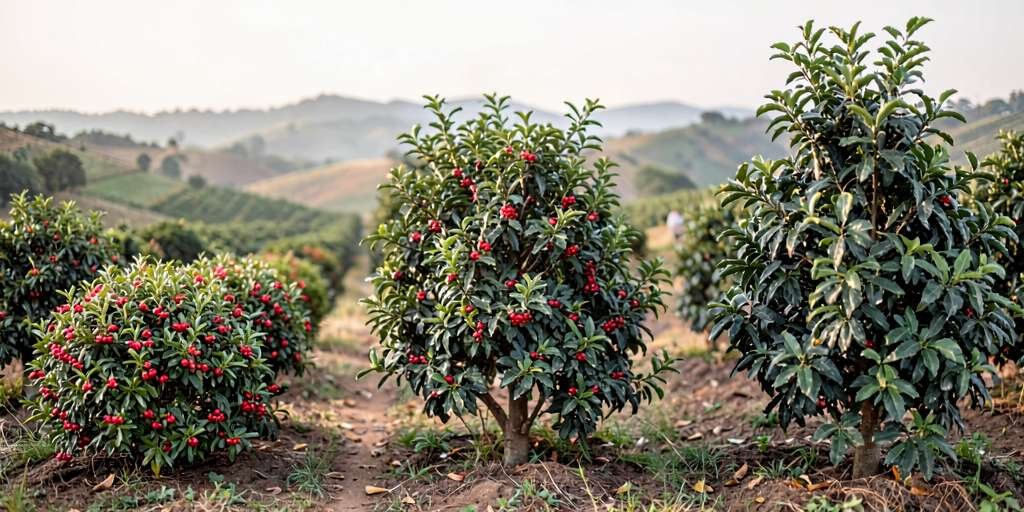
I had wanted to write about these three varieties for a while because they are the ones that cause the most confusion among coffee enthusiasts, even among producers. Caturra, Catuai, and Catimor share the same family tree, but they are radically different in agronomic behavior, disease resistance, and cup quality. The choice between them can make the difference between an award-winning specialty coffee and a standard commercial one. I researched their practical differences in depth, and what I found is worth knowing. Let’s get started!
Arabica coffee varieties in Central America and Brazil
Arabica coffee varieties are at the heart of coffee heritage in Central America and Brazil. Caturra, Catuai, and Catimor are among the most recognized and widely grown in these regions, each with its own characteristics and historical origins.
Origin and genetic evolution of Caturra, Catuai, and Catimor
Relationship with Bourbon and Mundo Novo
Caturra is a Bourbon mutant, while Catuai arose from a cross between Caturra and Mundo Novo. This genetic relationship has been key to obtaining desired characteristics in each variety, from flavor profiles to productivity. Catimor, for its part, comes from a cross between Timor (a natural Arabica-Robusta hybrid) and Caturra, which gives it its leaf rust resistance.
Influence of genetic crossing on yield
Genetic crossing has contributed not only to improving coffee quality, but also to the yield of each variety. The inherited characteristics determine their adaptation to different growing conditions and their resistance to disease.
Adaptation to altitude and climatic conditions
Altitude preferences of each variety
- Caturra grows best between 1,200 and 1,800 meters above sea level.
- Catuai shows broad adaptability and can be grown from 700 to 1,800 meters.
- Catimor, being more resistant, also adapts to different altitudes, with a focus on production.
Impact of climate on cherry quality
Climatic conditions are decisive in bean quality. Varieties such as Caturra and Catuai, grown at optimal altitudes, tend to offer higher cherry quality, thus enhancing their flavor profile.
Agronomic characteristics and plant management
Growth habit, size, and production cycle of the trees
The Caturra variety is shorter, which makes harvesting easier. Catuai has an intermediate growth habit, while Catimor tends to be more robust. The choice of planting system will depend on the growth habit to ensure good ventilation and light exposure. Caturra can start producing from the third year; Catimor, as a hybrid variety, is grown to obtain quicker yields.
Nutritional requirements and agronomic care
Fertilization and water management
The use of balanced fertilizers is crucial, especially for Caturra and Catuai, to reach their full potential. Water management is equally important, since excessive irrigation can be harmful to bean quality.
Pruning and harvesting methods for each variety
Pruning is essential to maintain plant health. Caturra and Catuai require training and maintenance pruning, while Catimor may require a different strategy because of its robustness and tendency to overproduce.
Resistance and management of coffee leaf rust
Vulnerability of Caturra and Catuai
Caturra is highly susceptible to coffee leaf rust, as is Catuai, although the latter shows some ability to adapt to growing conditions to minimize the impact. In areas with high rust pressure, the cost of fungicide treatments can compromise profitability.
Strategies with Catimor for affected areas
Catimor was specifically developed to offer disease resistance, making it a viable option in regions where leaf rust is prevalent. Growing it can help stabilize production in those contexts without the need for intensive chemical treatments.
Yield and productivity in today’s coffee farming
Production per hectare and influencing factors
Yield comparison between varieties
In general terms, Catuai tends to offer higher production per hectare under optimal conditions, reaching up to 1,000 kilograms. Caturra produces between 800 and 1,200 kilograms, while Catimor can match Catuai with an average of 1,200 kilograms. However, harvest quality has a decisive influence on the market value obtained.
Influence of agricultural management on productivity
Agricultural management is essential to maximize production. Practices such as proper fertilization, irrigation management, and pest control are decisive for the yield of each variety.
Influence of genetic potential on quality and quantity
Balance between yield and cup quality
Finding a balance between the quantity of coffee produced and cup quality is an ongoing challenge. Varieties such as Caturra and Catuai offer more complex flavor profiles, which can lead to a higher price in the market. It is essential for producers to evaluate this balance to meet both the demand for quality and the need for production.
Ideal situations for maximizing production
Caturra and Catuai tend to thrive at higher altitudes, while Catimor is better suited to climates where leaf rust resistance is crucial. Taking advantage of these conditions makes it possible to optimize both the quantity and quality of production.
Organoleptic profile and cup quality
Caturra’s sensory nuances and distinctive notes
Acidity, body, and aroma in the cup
Caturra is characterized by bright acidity, with a body that ranges from light to medium. This balance makes it a popular choice among cuppers. Its aroma can evoke citrus fruits, highlighting its freshness.
Influence of altitude and processing on flavor
Altitude plays a crucial role in Caturra’s quality. When grown between 1,200 and 1,800 meters, the beans develop a higher concentration of sugars and acidity. The processing method, whether washed or natural, also influences the complexity of the final flavor.
Cupping characteristics of Catuai
Predominant and balanced notes
Catuai offers a sweet and well-balanced cup. Its notes can include chocolate, nuts, and tropical fruit. This variety is recognized for its consistency in flavor, which makes it a reliable option for many producers.
Variations according to growing conditions
Growing conditions, such as soil type and climate, can alter Catuai’s sensory characteristics. If it is grown at lower altitudes, it may present a less intense flavor, but it remains pleasant and accessible.
Catimor: perceived quality and limitations in the cup
Comparison with traditional varieties
Catimor’s quality is often considered inferior compared with Caturra and Catuai. Although it has a heavier body and lower acidity, its nuances are less complex, which may disappoint more demanding palates.
Market preferences and potential for specialty coffees
Today’s market shows a growing trend toward specialty coffees, which may limit Catimor’s appeal. However, its disease resistance makes it valuable in certain regions where large-scale production and plantation health are priorities.
Practical considerations for producers
Choosing a variety according to the target market
Specialty coffees such as Caturra and Catuai are valued for their complexity of flavor and quality. Catimor may be better suited to large-scale production thanks to its resistance. Analyzing current trends can help producers adapt to changing consumer tastes; interest in sustainable, high-quality coffees is on the rise, which favors the choice of premium varieties.
Adaptation to soil and farm conditions
Soil acidity and drainage are important aspects that influence plant growth. Soil fertility can determine the level of available nutrients. Implementing crop rotation and the use of organic fertilizers are recommended practices to improve local performance.
Integrated pest and disease management
Caturra and Catuai require closer monitoring because of their vulnerability to disease. Catimor, with its resistance, can be easier to manage in pest situations. The use of organic pesticides and the promotion of biodiversity in crops contribute to a healthy, resilient ecosystem.
Economic aspects and sustainability in coffee farming
Costs associated with cultivation and maintenance
Varieties such as Caturra and Catuai usually require higher spending on inputs because of their specific management needs and vulnerability to disease. However, returns can also be higher with the right quality. The costs of leaf rust treatments are especially relevant for Caturra and Catuai in endemic areas.
Impact of sustainability on production and sales
Fair trade and sustainability certifications can increase the selling value of coffee. Producers who obtain these certifications often see higher returns by attracting consumers interested in responsible practices. Applying ecological practices, such as the use of organic fertilizers and biological pest control, can reduce costs in the long term.
Frequently asked questions from Coffee Lovers about these varieties
Which variety is most profitable for small farms?
Generally, Catuai tends to be the most profitable option for small coffee growers, given its high yield and adaptability to diverse conditions. Caturra, although it offers superior quality, may be less profitable due to its lower disease resistance and higher maintenance costs.
At what altitude does each variety perform best?
Caturra and Catuai thrive best between 1,200 and 1,800 meters above sea level, where cool conditions favor their development and cup quality. Catimor can adapt to lower altitudes, which makes it useful in disease-prone regions where other varieties would not be viable.
How does coffee leaf rust affect the specific yield of each plant?
Coffee leaf rust negatively impacts Caturra and Catuai, causing a considerable decrease in production and weakening the plants over time. Catimor shows greater resistance thanks to its resistance gene inherited from Timor, which makes it a viable option in areas with high pressure from this disease.
Which variety offers the best cup quality for specialty coffees?
Caturra is highly valued in the specialty coffee market because of its bright acidity and complex flavors. Catuai also has a good reputation, although its profile is more balanced. Catimor is usually less appreciated in this area because of its lower aromatic complexity.
Which agricultural practices are essential for maximizing genetic potential?
Proper fertilization, irrigation control, and effective pruning are essential to boost performance. Each variety requires specific management: Caturra and Catuai need more plant health attention; Catimor can simplify agronomic management, although it requires overproduction control.
What future does Catimor have in commercial coffee farming?
Catimor has an uncertain future in the quality coffee market because of its less complex flavor profile. However, in plantations where disease resistance and stable production are prioritized, it remains an attractive option. As climate change expands leaf rust pressure zones, its agronomic relevance may continue to increase.
At Coffee Sapiens, we never stop researching to bring you the agronomic details that make the difference between varieties that sound similar but produce very different coffees. Knowing the differences between Caturra, Catuai, and Catimor is key to better understanding what is in your cup. Thanks for being there, Coffee Lover!
{ “@context”: “https://schema.org”, “@type”: “FAQPage”, “mainEntity”: [ { “@type”: “Question”, “name”: “Which variety is most profitable for small farms?”, “acceptedAnswer”: { “@type”: “Answer”, “text”: “Catuai tends to be the most profitable for small coffee growers because of its high yield and adaptability. Caturra offers superior quality but may be less profitable due to its greater vulnerability to disease and maintenance costs.” } }, { “@type”: “Question”, “name”: “At what altitude does each variety perform best?”, “acceptedAnswer”: { “@type”: “Answer”, “text”: “Caturra and Catuai thrive between 1,200 and 1,800 meters, where cool conditions favor their cup quality. Catimor can adapt to lower altitudes, making it useful in regions with high leaf rust pressure.” } }, { “@type”: “Question”, “name”: “How does coffee leaf rust affect the specific yield of each plant?”, “acceptedAnswer”: { “@type”: “Answer”, “text”: “Coffee leaf rust negatively impacts Caturra and Catuai, causing lower production and weakening the plants. Catimor shows greater resistance thanks to its resistance gene from Timor, making it viable in areas with high pressure from this disease.” } }, { “@type”: “Question”, “name”: “Which variety offers the best cup quality for specialty coffees?”, “acceptedAnswer”: { “@type”: “Answer”, “text”: “Caturra is highly valued in specialty coffees for its bright acidity and complex flavors. Catuai has a good reputation with a more balanced profile. Catimor is usually less appreciated in this area because of its lower aromatic complexity.” } }, { “@type”: “Question”, “name”: “Which agricultural practices are essential for maximizing genetic potential?”, “acceptedAnswer”: { “@type”: “Answer”, “text”: “Proper fertilization, irrigation control, and effective pruning are essential. Caturra and Catuai need more plant health attention; Catimor simplifies agronomic management although it requires control of overproduction.” } }, { “@type”: “Question”, “name”: “What future does Catimor have in commercial coffee farming?”, “acceptedAnswer”: { “@type”: “Answer”, “text”: “It has an uncertain future in quality coffee but remains relevant in areas with leaf rust pressure. As climate change expands these areas, its agronomic relevance may continue to increase, especially for stable large-scale production.” } } ] }
Soy Javier Romero, especialista en Marketing Digital, Coffee Lover y redactor de Coffee Sapiens.
Bienvenidos a Coffee Sapiens. Somos un medio digital independiente dedicado a la divulgación, análisis y cultura del café.