
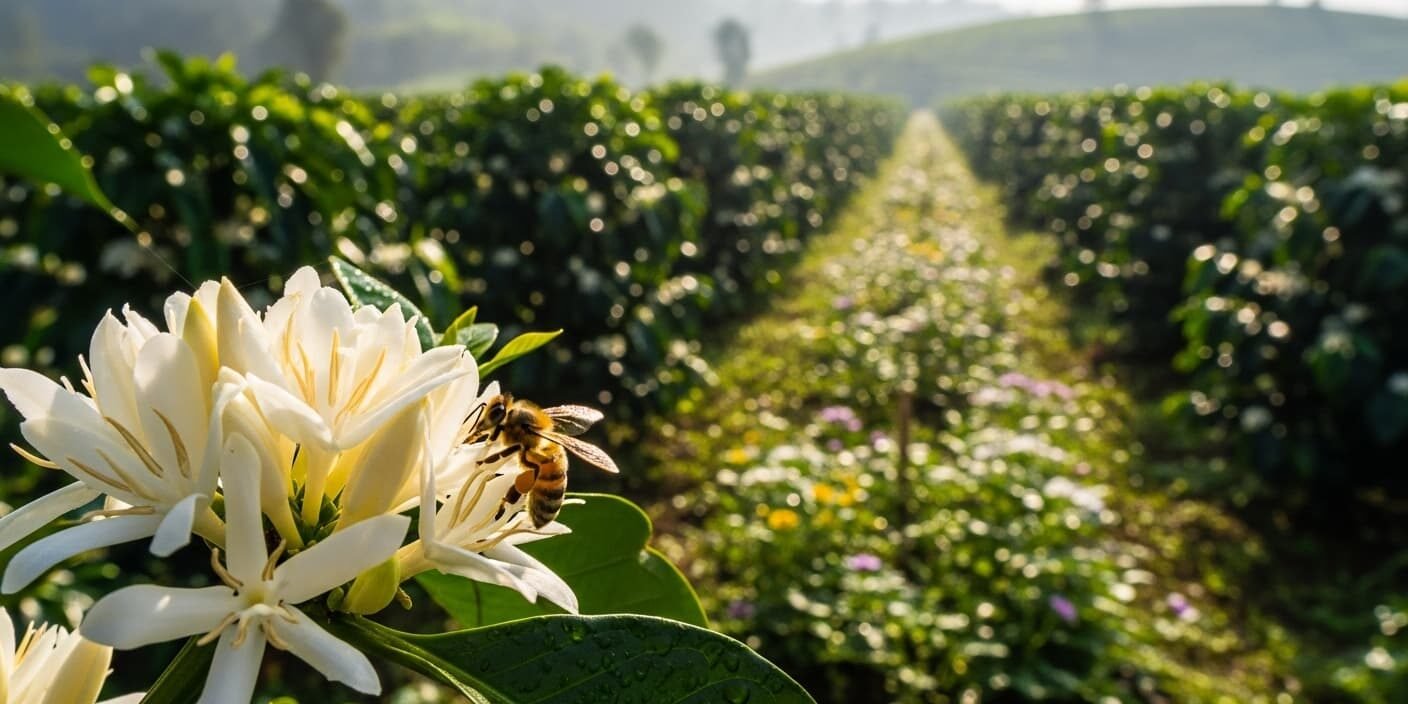
When I started researching the role of bees in coffee, I expected to find an important but perhaps secondary relationship. What I discovered surprised me: although arabica coffee can self-fertilize, studies show that bee pollination significantly improves bean weight and uniformity even in this variety, and in robusta —which depends much more on external pollinators— the effect is even more decisive.
I have researched how pollination in coffee really works, what differences exist between varieties, what threats bees face today, and what agricultural practices can help protect them. I hope this article gives you a more complete perspective on this often invisible connection between a tiny insect and the cup you have in your hands. Let’s begin!
Pollination and its role in coffee cultivation
Coffee plants produce hermaphroditic flowers that can, to a greater or lesser extent depending on the species, self-pollinate. Arabica coffee (Coffea arabica) is mostly self-pollinating: its flowers can fertilize themselves without external intervention. However, numerous field studies show that when bees visit these flowers, the cross-pollination they cause increases the fruit set rate, bean weight, and harvest uniformity compared with exclusive self-pollination. Robusta coffee (Coffea canephora), by contrast, is mostly self-incompatible: its flowers need pollen from another plant to set fruit, so it depends much more directly on pollinating insects —mainly bees— to produce a crop. In both cases, greater pollinating activity translates into a higher number of cherries per plant and a measurable improvement in final quality.
How pollination influences bean quality
Proper pollination affects three key aspects of quality: first, flavor and aroma, since well-pollinated plants tend to produce beans with a more complete development of aromatic compounds, which translates into more complex cupping profiles. Second, bean size and density: a higher fruit set rate and cross-pollination produce larger, more uniform beans, which are generally associated with better cup quality. And third, harvest uniformity: well-pollinated cherries ripen more synchronously, which makes selective picking easier and allows producers to work with lots that are more consistent in flavor and texture, something especially valued in specialty coffee.
Current threats to bees and their impact on coffee
Bee populations, which are essential to agriculture in general, face several threats with direct consequences for coffee. The use of pesticides, especially neonicotinoids, alters bees’ memory and navigational ability, making it harder for them to find coffee flowers and compromising pollination. The loss and fragmentation of natural habitats —due to urbanization and agricultural expansion— reduces the availability of nectar and pollen outside the coffee flowering season, weakening local pollinator populations. Finally, diseases and parasites such as the Varroa destructor mite weaken honey bee colonies, making them more vulnerable to other pathogens and reducing their effectiveness as pollinators.
Agricultural practices that protect bees
Various agricultural practices can benefit both bees and coffee quality. Designing habitats with native flowers within and around farms provides food for bees throughout the year, not just during coffee flowering, which keeps populations healthier and more robust. Reducing pesticide use, replacing it with biological pest control when possible, drastically lowers the negative impact on colonies. Organic and fair trade certifications often require or encourage this type of practice, making them an indicator (although not an infallible one) of more pollinator-friendly management. Diversified shade —growing coffee under trees of different species instead of in full-sun monoculture— also promotes the farm’s overall biodiversity, including bees.
The role of the consumer
As a consumer, choosing coffees from producers who practice sustainable agriculture or hold organic or fair trade certifications indirectly supports the conservation of healthy bee populations. This also has broader economic and cultural implications: the decline of pollinators directly affects yields and, therefore, the income of coffee-growing families, many of whom maintain coffee traditions passed down through generations. Supporting practices that protect bees is, ultimately, supporting the long-term viability of producing communities and, with it, the future availability of the quality coffees we enjoy.
Frequently asked questions about bees and coffee pollination
Does coffee really need bees to be produced?
Arabica coffee can be produced without bees because its flowers are mostly self-fertile, but studies show that the presence of bees improves the quantity and quality of the harvest even in this variety. Robusta coffee, by contrast, depends much more directly on cross-pollination by insects to set fruit properly. In both cases, the presence of active pollinators translates into better results.
How can I tell whether the coffee I buy comes from farms that protect bees?
There is no widely used specific certification for bee-friendly coffee, but organic and fair trade certifications usually involve restrictions on pesticides that benefit pollinators. Specialty roasters that work with origin transparency can often inform you about their producers’ agricultural practices, including the management of biodiversity and pollinators on the farm.
What is the relationship between shade-grown coffee and bees?
Coffee grown under diversified shade tends to support greater overall biodiversity on the farm, including populations of bees and pollinating insects. These systems provide food resources for bees during more months of the year, not just during coffee flowering, which helps maintain more stable and healthier populations.
Does the relationship with bees also affect other crops such as tea?
Yes, in a similar way. Tea (Camellia sinensis) also benefits from insect pollination, although to a lesser extent than many other crops. The relationship between pollinators and harvest quality/quantity is a pattern repeated across multiple perennial crops, which makes the conservation of healthy bee populations a relevant issue for sustainable agriculture in general.
What would happen to the price of coffee if bee populations kept declining?
If pollinator populations continued to decline, the yields of coffee plantations —especially robusta ones— would be negatively affected, which would put upward pressure on prices in the global market. In specialty coffees, where bean quality is a priority, the impact would be even more noticeable because bean uniformity and size —both dependent on good pollination— are determining factors in the final score and in the price reached by the best lots.
I hope this overview of the relationship between bees and coffee has given you a new perspective on everything behind each cup. At Coffee Sapiens, we never stop researching and learning things about the wonderful world of coffee, so stay tuned because I will soon be posting more updates on the blog. Thanks for being there, Coffee Lover!
{ “@context”: “https://schema.org”, “@type”: “FAQPage”, “mainEntity”: [ { “@type”: “Question”, “name”: “Does coffee really need bees to be produced?”, “acceptedAnswer”: { “@type”: “Answer”, “text”: “Arabica can be produced without bees because it is mostly self-fertile, but their presence improves the quantity and quality of the harvest. Robusta depends much more directly on cross-pollination by insects.” } }, { “@type”: “Question”, “name”: “How can I tell whether the coffee I buy comes from farms that protect bees?”, “acceptedAnswer”: { “@type”: “Answer”, “text”: “There is no widely used specific certification, but organic and fair trade certifications involve restrictions on pesticides that benefit pollinators. Specialty roasters with transparent sourcing can inform you about their producers’ practices.” } }, { “@type”: “Question”, “name”: “What is the relationship between shade-grown coffee and bees?”, “acceptedAnswer”: { “@type”: “Answer”, “text”: “Diversified shade-grown coffee supports greater biodiversity, including bee populations, by providing food resources for more months of the year and maintaining more stable and healthier populations.” } }, { “@type”: “Question”, “name”: “Does the relationship with bees also affect other crops such as tea?”, “acceptedAnswer”: { “@type”: “Answer”, “text”: “Yes. Tea also benefits from insect pollination, although to a lesser extent. The relationship between pollinators and harvest quality is repeated across multiple perennial crops.” } }, { “@type”: “Question”, “name”: “What would happen to the price of coffee if bee populations kept declining?”, “acceptedAnswer”: { “@type”: “Answer”, “text”: “The yields of coffee plantations would be affected, putting upward pressure on prices. In specialty coffees, the impact would be especially noticeable, since bean uniformity and size —which depend on good pollination— are key factors in the score and price of the best lots.” } } ] }

Soy Javier Romero, especialista en Marketing Digital, Coffee Lover y redactor de Coffee Sapiens.
Bienvenidos a Coffee Sapiens. Somos un medio digital independiente dedicado a la divulgación, análisis y cultura del café.