
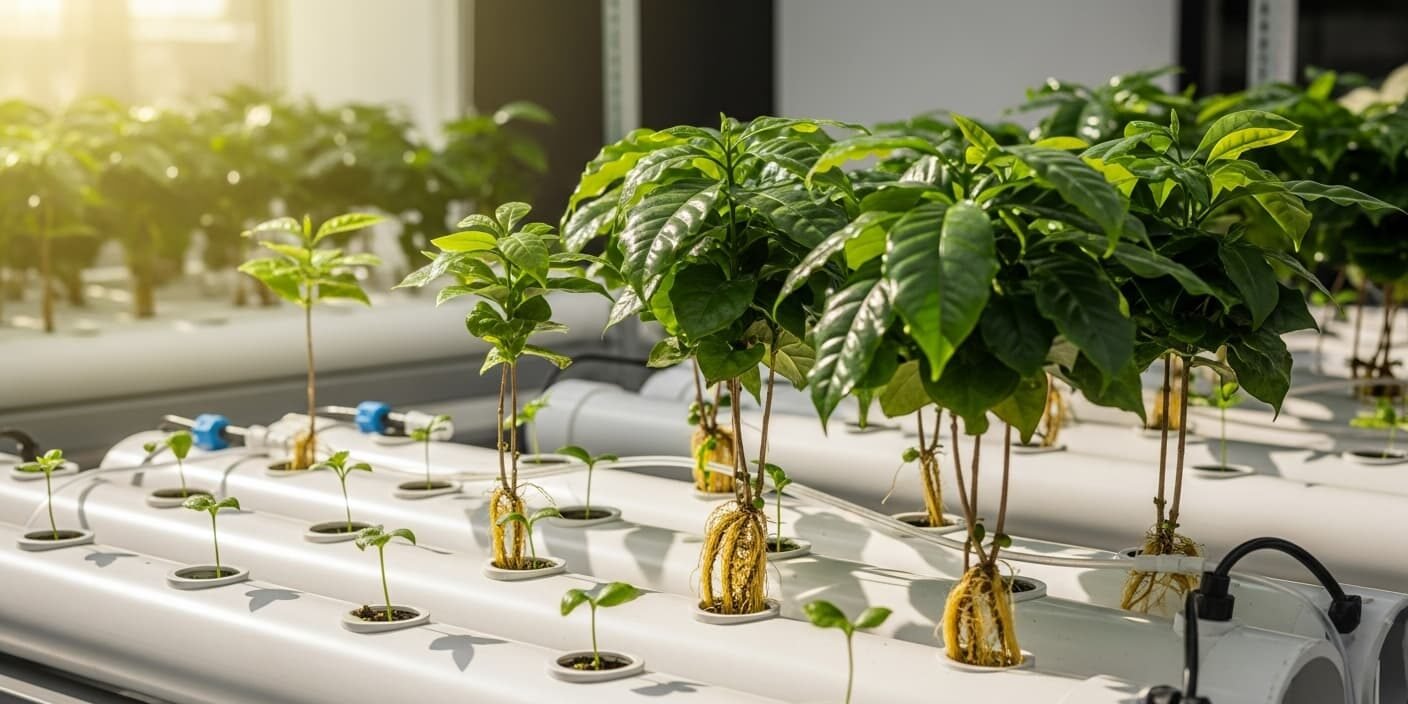
When someone asks me whether coffee can be grown at home with hydroponics, my first reaction is enthusiasm—of course it sounds fascinating!—but I quickly feel the responsibility to be honest about what it really involves. The coffee plant is a tropical evergreen tree that takes years to mature, and home hydroponics, although possible as an experimental and decorative project, is far from being a realistic way to “produce your own coffee” in the short term.
I’ve researched what you would really need to try this project, what expectations are reasonable, and why the overwhelming majority of people who try it do so out of botanical curiosity rather than the idea of harvesting their own coffee. I hope this article gives you an honest perspective before you embark on this adventure. Let’s begin!
The coffee plant: characteristics and realistic timelines
The coffee plant (mainly Coffea arabica for this type of project, because its size is somewhat more manageable than robusta) is a tropical evergreen shrub that, under optimal conditions, takes between 3 and 5 years from planting to produce its first flowering and, eventually, cherries. In a pot and indoors, without the conditions of a real coffee farm, this time frame becomes considerably longer and, in many cases, the plant never flowers. It is important to understand this from the beginning: a home hydroponic coffee-growing project is, above all, a long-term botanical experiment with very low harvest expectations, not a shortcut to getting your own coffee in a short time.
How to start: germination and hydroponic system
Germination starts with viable green coffee seeds (not all commercial green coffee seeds are viable for germination, since many have been processed or stored in a way that causes them to lose germination capacity). The typical process includes soaking the seeds in water for 24 hours and then sowing them in a moist substrate (peat moss and vermiculite are common combinations) with indirect light, kept constantly moist but not waterlogged; germination can take between 1 and 3 months, with variable success rates. Once the plant has a minimally developed root system, it can be moved to a hydroponic system: deep water culture (DWC) or drip systems are usually more manageable for beginners. The nutrient solution should be formulated for evergreen plants, adjusted to a slightly acidic pH (around 6.0-6.5).
Environmental conditions needed at home
The coffee plant needs stable temperatures between 18 and 24°C, high relative humidity (60-70%, difficult to maintain in many homes without a humidifier), and bright indirect light for 10-12 hours a day. Replicating these conditions in a normal home without a greenhouse, grow tent with full-spectrum LED lights, and temperature/humidity control is very difficult. This does not mean that it is impossible to keep a coffee plant alive and healthy at home—as an ornamental indoor plant it can do well with basic care—but bringing it to the point of flowering requires a level of environmental control that goes far beyond caring for a conventional houseplant.
If you do get cherries: what to do next
In the unlikely but possible scenario, after several years of optimal care, that your coffee plant flowers and produces a few cherries, the process that follows is based on the same principles as on any farm: harvest the cherries when they are deep red, depulp them and ferment them briefly to remove the mucilage, dry them until they reach 10-12% moisture, and finally roast them in tiny quantities using a small home roaster or a frying pan. With such reduced quantities, the result will be more of a curiosity and a memento of the process than an amount of coffee you can actually use to brew a real cup.
Common mistakes and realistic expectations
The most frequent mistakes are overfertilization (too much can damage the roots), incorrect watering or solution level (both excess and deficiency seriously affect the root system), and above all, disproportionate expectations about timing and results. The healthiest way to approach this project is for what it really is: an educational experience and a connection with the plant that gives you the coffee you drink every day, not a substitute for buying specialty coffee from producers who do have the right conditions to grow it at scale and with quality.
Frequently asked questions about hydroponic coffee growing
Can I really end up getting coffee to drink by growing it at home?
It is very unlikely, and if it does happen, it would be in symbolic quantities (just a few beans), not enough to make even one full cup. The realistic purpose of this kind of project is educational and experimental: to understand the plant’s life cycle, enjoy having it as a decorative indoor element, and better appreciate the work behind the coffee you normally buy.
What’s the difference between growing a coffee plant in soil and hydroponically at home?
In soil, the coffee plant is more tolerant of fluctuations and easier for beginners to maintain. In hydroponics, control over nutrients and pH is more precise, but it introduces more variables that can go wrong and requires more active monitoring. For someone who simply wants to keep a coffee plant as an indoor plant, growing in traditional substrate is usually simpler.
Can I use seeds from a regular bag of whole-bean coffee to germinate?
In most cases, no. Roasted coffee has its seed viability destroyed by heat. Commercial green coffee also usually has very low germination viability depending on storage. To germinate coffee, you need seeds specifically sold as viable for planting, usually from nurseries specialized in tropical plants.
Is this project worth trying if I like specialty coffee?
It depends on your motivation. If you approach it as a curious gardening project, without expectations of real production, it can be an interesting and educational experience. If your motivation is ‘to grow my own specialty coffee,’ I recommend redirecting that energy toward exploring different origins or visiting coffee farms, which will give you a much richer connection to specialty coffee.
How long does it take for a coffee plant to produce its first harvest in home conditions?
Under optimal field conditions, the coffee plant starts producing cherries between 3 and 5 years. At home, without the altitude, climate, and soil conditions of a real coffee farm, that time frame becomes considerably longer—and in many cases the plant never flowers. With hydroponics and strict environmental control, it is possible to try to speed up the process, but it is difficult to talk about specific time frames because it depends on many variables. The most honest approach is to treat it as a long-term project with no guaranteed harvest date.
I hope this honest guide to hydroponic coffee growing at home helps you decide, with real information, whether this project fits what you are looking for. At Coffee Sapiens we never stop researching and learning about the wonderful world of coffee, so stay tuned because I’ll keep posting new updates to the blog soon. Thanks for being there, Coffee Lover!
{ “@context”: “https://schema.org”, “@type”: “FAQPage”, “mainEntity”: [ { “@type”: “Question”, “name”: “Can I really end up getting coffee to drink by growing it at home?”, “acceptedAnswer”: { “@type”: “Answer”, “text”: “It is very unlikely, and if it happens it would be in symbolic quantities. The realistic purpose is educational and experimental: to understand the plant’s life cycle and better appreciate the work behind the coffee you buy.” } }, { “@type”: “Question”, “name”: “What’s the difference between growing a coffee plant in soil and hydroponically at home?”, “acceptedAnswer”: { “@type”: “Answer”, “text”: “In soil it is more tolerant of fluctuations and easier for beginners. In hydroponics, nutrient and pH control is more precise, but it introduces more variables that can fail and requires more active monitoring.” } }, { “@type”: “Question”, “name”: “Can I use seeds from a regular bag of whole-bean coffee to germinate?”, “acceptedAnswer”: { “@type”: “Answer”, “text”: “In most cases, no. Roasting destroys the seed’s viability, and commercial green coffee also usually has very low germination viability. You need seeds specifically sold for planting.” } }, { “@type”: “Question”, “name”: “Is this project worth trying if I like specialty coffee?”, “acceptedAnswer”: { “@type”: “Answer”, “text”: “If you approach it as a curious gardening project without production expectations, it can be educational. If you want to grow your own specialty coffee, exploring origins or visiting farms will give you a much richer connection.” } }, { “@type”: “Question”, “name”: “How long does it take for a coffee plant to produce its first harvest in home conditions?”, “acceptedAnswer”: { “@type”: “Answer”, “text”: “In the field, between 3 and 5 years. At home, that time frame becomes considerably longer, and in many cases the plant never flowers. The most honest approach is to treat it as a long-term project with no guaranteed harvest date.” } } ] }

Soy Javier Romero, especialista en Marketing Digital, Coffee Lover y redactor de Coffee Sapiens.
Bienvenidos a Coffee Sapiens. Somos un medio digital independiente dedicado a la divulgación, análisis y cultura del café.