
When I started taking specialty coffee at home seriously, choosing a grinder was the decision I researched the most and the one I regretted most at first. I bought a grinder that was too cheap, thinking it made no difference, and it took me months to understand that the inconsistencies I was getting in flavor came almost entirely from there. Grinding is the most critical link between the bean and the cup, and understanding the real differences between burr types and between manual and electric is the first step toward making the right decision. Let’s begin!
The impact of the grinder on coffee quality
Fresh grinding is essential: when the beans are ground, the essential oils are released and progressively oxidize. A grinder that allows you to grind just before brewing maximizes aromatic potential. Particle size determines extraction speed: fine for espresso (fast extraction), coarse for French press or cold brew (slow extraction). Uniformity in size ensures balanced extraction, preventing some particles from over-extracting while others remain under-extracted. Retention of ground coffee in the grinder also affects freshness: old coffee in the chamber contaminates the next grind.
Characteristics of manual grinders
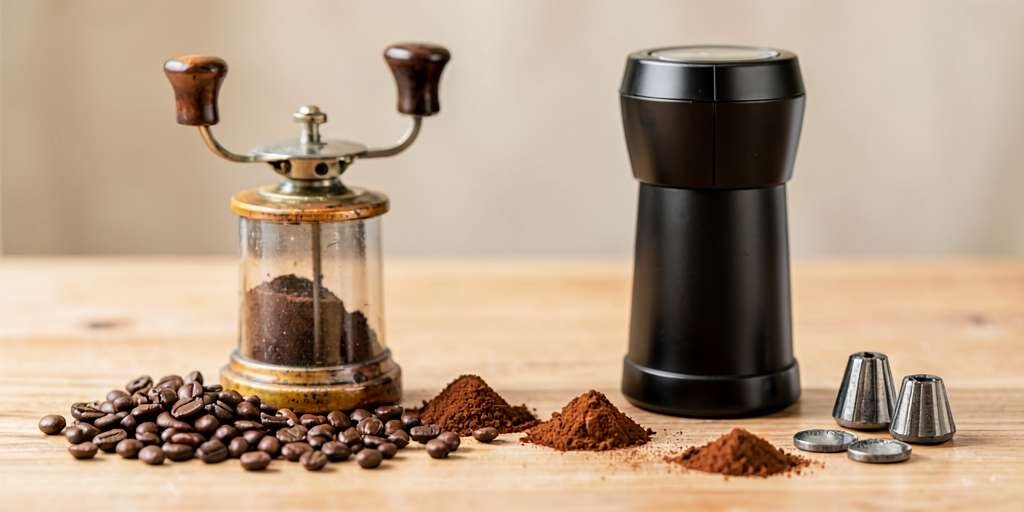
Manual grinders almost always use conical burrs, which take advantage of gravity in the vertical grinding process. Their design allows precise grind size adjustment and produces more uniform particles than blade grinders. Portability is a real advantage: they are compact, light, and do not need electricity. Quality materials (stainless steel or good-quality ceramic) ensure durability. Their main limitation is the time and manual effort involved, especially for fine grinds or large quantities.
Advantages and disadvantages of electric grinders
Speed is their main appeal: they grind in seconds and are essential in high-use environments. Electric grinders can have flat or conical burrs. Flat burrs offer a narrower and more uniform size distribution—ideal for espresso—but generate more heat. Conical burrs operate at lower temperature and speed, preserving aromatic oils better, and work excellently for filter methods. Their biggest drawback is cost: models of sufficient quality for specialty coffee are significantly more expensive than equivalent manual grinders.
Detailed comparison between flat and conical burrs
Flat burrs consist of two horizontal rings that produce a narrower and bimodal size distribution (many fines and many coarse particles, with few in between). Conical burrs generate a unimodal distribution with more particles around the central size. For espresso, flat burrs usually provide greater consistency and precision. For filter, conical burrs stand out for lower heat generation and less oil oxidation. Flat burrs require more power and speed, which generates more heat. Conical burrs are quieter and generate less heat, although in cheap models uniformity may be lower.
Materials used in burrs and their effect on grinding
Hardened steel is the quality standard: durable, it keeps its edge for thousands of grinds and produces consistent particles. Ceramic is affordable and does not transfer heat, but it wears out faster and can chip. Plastic only appears in very cheap entry-level models and notably limits consistency. For serious home use, hardened steel burrs are the only recommendable long-term option.
Choosing the right grinder according to lifestyle and preferences
A manual grinder is ideal for someone who makes 1-2 cups a day, travels frequently, or values the grinding ritual. Electric grinders are essential for heavy use (more than 3-4 cups daily), professional environments, or when speed is a priority. For espresso: prioritize flat burrs in an electric grinder or a high-end manual grinder (1Zpresso, Comandante). For filter: conical burrs in a manual or mid-range electric grinder offer excellent results. The appropriate grind varies: fine for espresso, medium for V60/Chemex, coarse for French press and cold brew.
Current and future trends in burr grinders
The most relevant advances include integrated anti-static systems (ionizers) that keep fines from sticking to surfaces, optimized chamber designs for minimal retention, more sustainable materials, and larger-diameter burrs that allow grinding at lower speed with less heat. In 2026, the prosumer market trend points to high-performance manual grinders with large-diameter burrs (47mm+) capable of competing with mid-range electric grinders.
Care and maintenance for optimal grinding
Brush the burrs with a soft brush every week and use cleaning tablets (such as Grindz) monthly. Never use water on the burrs of electric grinders. Check burr alignment every few months. Store in a dry place protected from impacts. Correct adjustment of the distance between burrs is essential: if they are too close, they generate excessive heat; if they are too far apart, they produce uneven grinding.
Frequently asked questions about coffee grinders
What is the real difference between conical and flat burrs in the cup?
Flat burrs tend to produce brighter and more precise profiles, especially in espresso, because their narrower size distribution allows more even extraction. Conical burrs usually deliver profiles with more body and smoothness, especially in filter brewing. The difference is noticeable in controlled tastings, but it depends heavily on the quality of the specific grinder: a high-end conical grinder easily outperforms a low-end flat one.
Is a high-end manual grinder worth it compared with a mid-range electric one?
For filter, yes: manual grinders like the 1Zpresso J-Max or the Comandante C40 produce results comparable to or better than mid-range electric grinders at a fraction of the price. For espresso, the advantage narrows because very fine adjustments require greater precision and consistency, which is where dedicated espresso electric grinders have the edge.
Are blade grinders a valid option for specialty coffee?
No. Blade grinders do not grind; they chop randomly, generating a mix of particles of very different sizes. This makes even extraction impossible and the result will always be inconsistent, with an excess of fines that over-extract and large particles that under-extract. An entry-level burr grinder (20-40€) is already significantly better than any blade grinder.
How often should a grinder’s burrs be replaced?
It depends on the material and usage. Quality hardened steel burrs can handle between 500 kg and 1000 kg of ground coffee before needing replacement. Under normal household use (250-500g per month) that equals several years. Ceramic burrs wear out sooner. The clearest indicator of wear is the loss of uniformity in the grind and the need to adjust progressively finer to get the same result.
How does the heat generated during grinding affect coffee?
Excessive heat during grinding can volatilize aromatic compounds that would otherwise reach the cup. In fast grinders with flat burrs, friction generates more heat. The most effective solution is to grind in short bursts instead of long continuous grinding sessions, and to choose grinders with large-diameter burrs that can turn more slowly for the same throughput.
At Coffee Sapiens, we never stop researching to bring you information that helps you make better decisions at every link in the coffee chain. The grinder is probably the most impactful investment you can make to improve your coffee at home. Thank you for being here, Coffee Lover!
{ “@context”: “https://schema.org”, “@type”: “FAQPage”, “mainEntity”: [ { “@type”: “Question”, “name”: “What is the real difference between conical and flat burrs in the cup?”, “acceptedAnswer”: { “@type”: “Answer”, “text”: “Flat burrs tend to produce brighter profiles in espresso due to their narrower size distribution. Conical burrs usually deliver profiles with more body in filter brewing. The difference depends heavily on the quality of the specific grinder: a high-end conical grinder outperforms a low-end flat one.” } }, { “@type”: “Question”, “name”: “Is a high-end manual grinder worth it compared with a mid-range electric one?”, “acceptedAnswer”: { “@type”: “Answer”, “text”: “For filter, yes: grinders like the 1Zpresso J-Max or the Comandante C40 produce results comparable to mid-range electric grinders. For espresso, dedicated electric grinders have the advantage in precision and consistency.” } }, { “@type”: “Question”, “name”: “Are blade grinders a valid option for specialty coffee?”, “acceptedAnswer”: { “@type”: “Answer”, “text”: “No. Blade grinders chop randomly, generating particles of very different sizes, which makes even extraction impossible. An entry-level burr grinder (20-40€) is already significantly better.” } }, { “@type”: “Question”, “name”: “How often should a grinder’s burrs be replaced?”, “acceptedAnswer”: { “@type”: “Answer”, “text”: “Hardened steel burrs last between 500 kg and 1000 kg of coffee. Under normal household use, that equals several years. The indicator of wear is loss of uniformity and the need to adjust progressively finer to get the same result.” } }, { “@type”: “Question”, “name”: “How does the heat generated during grinding affect coffee?”, “acceptedAnswer”: { “@type”: “Answer”, “text”: “Heat can volatilize aromatic compounds. The solution is to grind in short bursts and choose grinders with large-diameter burrs that rotate more slowly for the same output.” } } ] }
Soy Javier Romero, especialista en Marketing Digital, Coffee Lover y redactor de Coffee Sapiens.
Bienvenidos a Coffee Sapiens. Somos un medio digital independiente dedicado a la divulgación, análisis y cultura del café.