
📢 — Listen to the content of this article — 📢
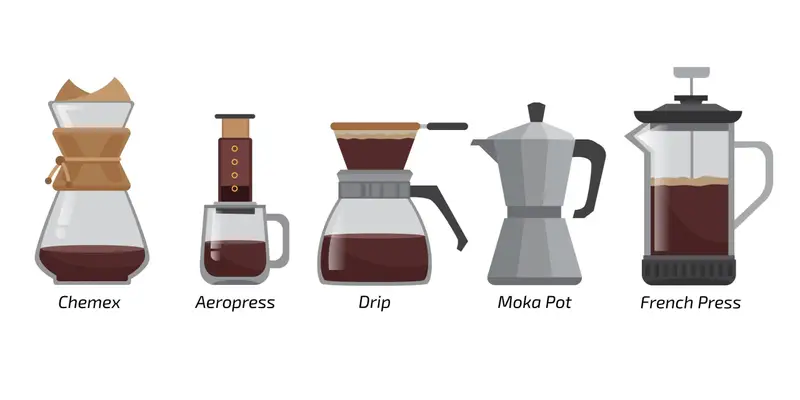
We see that many of the most common queries made on search engines have to do with coffee brewing methods, so at Coffee Sapiens we have prepared a detailed comparison table of the most popular brewing methods. We have organized the information so you can quickly see the key differences in flavor, technique, and requirements. Let’s get down to it:
Coffee Brewing Methods Comparison Table
| Method | Principle | Grind | Ratio (Coffee:Water) | Total Time | Flavor Profile | Difficulty |
| Espresso | Pressure (9 bars) | Fine (like talcum powder) | 1:2 | 25-30 sec | Intense, full-bodied, creamy, and concentrated. | High (requires a machine and technique) |
| Moka (Italian) | Steam pressure | Fine-Medium (like fine salt) | 1:7 – 1:10 | 3-5 min | Strong, bittersweet, dense-bodied (close to espresso). | Medium-Low |
| Aeropress | Immersion + Pressure | Medium-Fine | 1:12 – 1:16 | 1-2 min | Versatile. It can be intense or light depending on the recipe. Sweet. | Low (very forgiving) |
| V60 (Drip) | Filtration / Gravity | Medium (like sea salt) | 1:15 – 1:17 | 2:30 – 3 min | Clean, complex, highlights acidity and fruity/floral notes. | Medium-High (requires pour control) |
| Chemex | Filtration (Thick filter) | Medium-Coarse | 1:15 – 1:17 | 4-5 min | Extremely clean, sediment-free, light-bodied, elegant. | Medium (the thick filter is more forgiving than the V60) |
| French Press | Full immersion | Coarse (like breadcrumbs) | 1:12 – 1:15 | 4 min | Heavy body, textured, rich, and with natural oils (more «muddy»). | Low |
| Cold Brew | Cold steeping | Very Coarse | 1:5 (conc.) to 1:10 | 12-24 hours | Very smooth, low acidity, sweet, and with a silky body. | Very Low (only requires patience) |
Keys to choosing your method
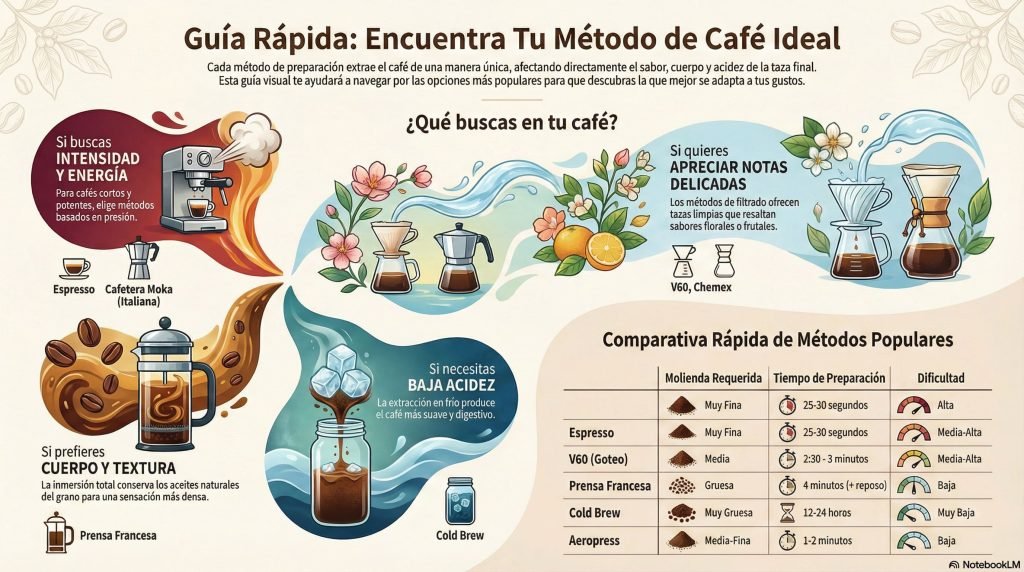
- If you’re looking for intensity and energy: Espresso or Moka reign supreme. They are short, powerful coffees.
- If you want to appreciate the notes of a specialty coffee: V60 or Chemex are ideal because they «clean up» the cup and allow floral or fruity flavors to shine without the «roasted» taste or heavy oils.
- If you prefer body and texture: The French Press preserves the bean oils that paper filters trap, giving a thicker mouthfeel.
- If you have a sensitive stomach: Cold Brew is the least acidic of all due to cold extraction, making it very gentle on the stomach.
1. French Press (Immersion technique)
This technique (based on James Hoffmann’s modern method) avoids that gritty, bitter sludge typical of poorly made French presses.
- Ratio: 1:15 (For every 1 gram of coffee, 15 grams of water).
- Recommended dose: 20 g of coffee for 300 ml of water (for 1 person).
- Grind: Coarse (texture of coarse sea salt or breadcrumbs).
- Water temperature: 95°C (or let the water rest for 1 min after boiling).
Step by step
- The Pour: Add the 20 g of coffee to the press. Pour in the 300 ml of hot water, making sure to wet all the dry coffee.
- The Wait (Crucial): Put the lid on to retain heat but DO NOT press the plunger down yet. Let it rest for 4 minutes.
- Breaking the crust: After 4 minutes, remove the lid. You will see a floating coffee «crust.» With a spoon, gently stir the surface so the coffee falls to the bottom.
- Cleaning: You will see a whitish foam and bubbles on the surface. Remove it with the spoon and throw it away (that foam is usually bitter).
- The Secret to Clarity: Put the lid back on and lower the plunger only until it touches the surface of the liquid (do not press it all the way down).
- Patience: Wait 5 more minutes (yes, really). This allows the fine particles to settle at the bottom and not make it into your cup.
- Serve: Pour gently without shaking the press. Leave the last bit of liquid in the press (that’s where the sediment is).
Result: A sweet, full-bodied cup with a silky texture and surprisingly clean for a French press.
Recommended French Press
Bialetti Preziosa French Press
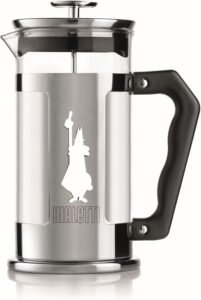
Made of heat-resistant borosilicate glass and stainless steel, the Bialetti Preziosa French Press offers even extraction and an elegant design that fits into any kitchen. Its double-filter plunger improves cup clarity and prevents residue. Available in various capacities, it is easy to clean and perfect for those seeking a rich, full-bodied, hassle-free coffee experience. Ideal for preparing everything from a quick breakfast to a more refined tasting session.
2. Moka / Italian (The faux espresso)
The goal here is to avoid a burnt/metallic taste and achieve sweetness.
- Ratio: Determined by the funnel (always fill it), but use an approximate water ratio of 1:10.
- Grind: Fine (like table salt), but coarser than for espresso.
- Pro Tip: Use already hot water in the reservoir.
Step by step
- Hot water: Fill the base with boiling water up to just below the valve. (This prevents the coffee from «cooking» while the water heats on the stove).
- The Coffee: Fill the funnel with coffee to the top. DO NOT press or tamp it. Level it gently with your finger.
- Heat: Close the coffee maker (use a cloth, the base gets hot) and place it over medium-low heat. We want gentle extraction, not violent extraction.
- Lid open: Leave the lid up so you can keep an eye on it.
- The cut: As soon as the coffee starts coming out in a pale honey color and starts to «bubble» or sputter air, remove it from the heat immediately.
- Thermal shock: Run the base of the coffee maker under cold tap water for 5 seconds to stop the extraction instantly. Serve immediately.
Recommended Moka Pot
Bialetti Venus Moka Pot
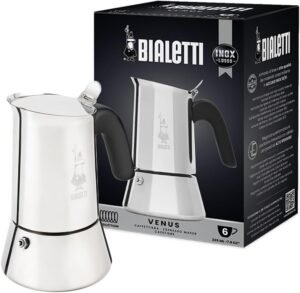
Made of 18/10 stainless steel, the Bialetti Venus Moka Pot combines elegance and durability. Compatible with induction, gas, and electric stovetops, it achieves a full-bodied coffee with intense aroma thanks to its double-wall design that distributes heat evenly. Its ergonomic handle and safety valve improve the user experience, while its polished finish makes it a sophisticated everyday piece. Ideal for those seeking the traditional flavor of Italian espresso with a modern touch.
3. V60 (Precision and clarity)
Baristas’ favorite method for fruity and floral coffees.
- Ratio: 1:16 (15g of coffee / 250ml of water).
- Grind: Medium (like kosher salt or beach sand).
- Temperature: 93°C – 96°C.
Step by step
- Pre-rinse: Place the paper filter and wet it with hot water to remove the paper taste and warm the carafe. Discard that water.
- Bloom: Add the 15g of coffee. Pour 40-50g of water (double or triple the weight of the coffee). Make sure to wet it all. Wait 45 seconds. You will see bubbles (CO2 escaping).
- Steady pour: Start pouring gently in concentric circles (without touching the walls of the filter). Try to pour the rest of the water slowly until you reach 250g total.
- Rao Spin: When you finish pouring, grab the V60 and make a small circular movement (swirl) so the coffee bed ends up flat at the end.
- Total time: The water should finish draining between 2:30 and 3:00.
Recommended V60 Coffee Maker
Hario V60 Coffee Maker
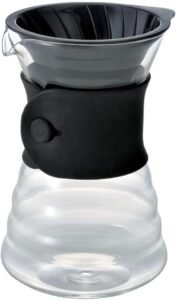
The Hario V60 Coffee Maker is synonymous with precision and purity in every cup. Made of high-quality glass with an inner spiral that promotes even water flow, it allows total control over flow and extraction time. Its cone-shaped design and spiral ridges enhance clarity and highlight the finest nuances of the coffee, ideal for medium or light roast beans. Available in various sizes and materials, it is perfect for those who enjoy the ritual of manual pouring and seek a clean, aromatic, and balanced cup.
4. Aeropress (Inverted method)
The Swiss Army knife. We will use the «inverted» method to prevent the water from escaping too early.
- Ratio: Approx. 1:14 (12g coffee / 200g water) for a long but intense cup.
- Grind: Medium-fine (slightly finer than V60).
- Temperature: 90°C (the Aeropress prefers slightly lower water).
Step by step
- Invert: Put the plunger inside the tube about 2 cm and turn it upside down (so the plunger is the base).
- Coffee and Water: Add the coffee. Pour in the 200g of water all at once (no need to be delicate here).
- Stir: Stir vigorously with the paddle for 10 seconds.
- Rest: Let it rest for 1 minute. Meanwhile, place the paper filter in the black cap and wet it.
- Flip and Press: Screw on the cap with the filter. Put your cup upside down on the cap. Hold everything together and flip it over decisively.
- Press: Press the plunger gently until you hear a hissing sound of air (about 30 sec pressing down). Done!
Recommended AeroPress Coffee Maker
AeroPress Clear Coffee Maker
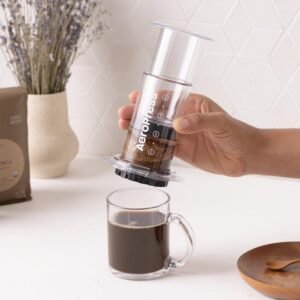
Made with durable materials and a transparent design that lets you appreciate the entire extraction process, the AeroPress Clear Coffee Maker combines practicality and precision in a single device. Its controlled-pressure system offers an intense, clean, sediment-free cup in under two minutes, perfect for both home and travel. Lightweight, easy to clean, and versatile (it allows you to prepare espresso-style coffee, Americano, or cold brew), it has become a benchmark among coffee enthusiasts seeking experimentation and consistency in every extraction. It is available in two sizes and 8 different colors.
5. Chemex (Pure elegance)
Similar to the V60 but it produces a much cleaner and lighter cup due to its thick filter.
- Ratio: 1:16 (30g of coffee / 500ml of water). The Chemex works best with large quantities.
- Grind: Medium-Coarse (coarser than V60, like coarse sea salt).
- Temperature: 96°C.
Step by step
- The Filter: The Chemex filter is square. Open it so that you have 3 layers toward the spout side of the carafe (so airflow does not get blocked) and 1 layer on the other side. Wet it A LOT (it has a strong paper taste).
- Bloom: Pour 60-90g of water over the coffee. Stir a little if needed. Wait 45 sec.
- Pulse pouring: Unlike the V60, pour calmly here. Fill halfway, let it drain a bit, fill again. Keep the water level high to maintain the temperature.
- Time: It should take between 4:00 and 5:00 minutes in total. If it takes longer, grind coarser next time.
Recommended Chemex Coffee Maker
YunNasi Pour Over Chemex Coffee Maker
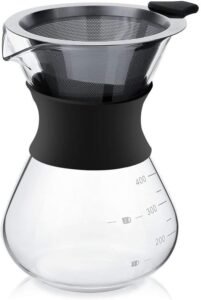
Made of heat-resistant glass and with an elegant polished wooden collar, the YunNasi Pour Over Chemex Coffee Maker combines classic design and functionality. Its special filter, thicker than the standard one, retains oils and sediment, resulting in a clean, light cup with a silky texture. Ideal for those who value aesthetics as much as coffee purity, it allows you to prepare several servings at once without losing consistency in flavor. Perfect for highlighting light roasts and delicate aromatic profiles.
6. Espresso (The exact science)
Here it depends on your machine, but this is the universal «Base Recipe.»
- Ratio: 1:2 (For every gram of dry coffee, you get 2 grams of liquid in the cup).
- Typical dose: 18g of coffee -> to pull 36g of liquid espresso.
- Time: 25 to 30 seconds.
- Grind: Very fine.
Step by step
- Cleaning: Purge the group head (let water run) to heat it and clean it.
- Preparation: Grind the 18g. Distribute the coffee in the portafilter so it is even (without clumps).
- Tamping: Press with the tamper perfectly straight. Force is not as important as consistency and keeping it level.
- Extraction: Place the scale under the cup. Start the extraction and the timer at the same time.
- Adjustment:
- If you pull 36g in less than 25 sec: Grind finer.
- If you pull 36g in more than 30 sec: Grind coarser.
Recommended Espresso Machine
De’Longhi Dedica Espresso Machine
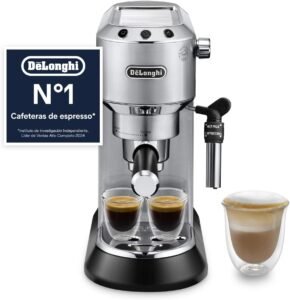
Compact and powerful, the De’Longhi Dedica Espresso Machine combines elegance and precision in a slim format that fits into any kitchen. With a 15-bar pump and a Thermoblock heating system, it reaches the ideal temperature in seconds to achieve a consistent and creamy extraction. It allows you to adjust the amount of coffee, the temperature, and the pre-infusion time, offering total control over preparation. Its manual milk frother creates a silky texture ideal for cappuccinos and lattes, while its stainless steel design and professional portafilter ensure durability and style. Perfect for those seeking the authentic espresso experience at home without sacrificing design or ease of use.
Now comes the most critical factor: your grinder.
What grinder are you using? Is it a blade grinder or a burr grinder? Knowing this is vital because recipes like V60 or Espresso are impossible to calibrate properly with a blade grinder.
If you want to learn more about the coffee grinder that’s right for you, you can visit our grinder guide.
Frequently Asked Questions
1. What is the best method for beginners?
The French Press is usually the most recommended starting point, since it is simple, tolerates small errors in grind size or steep time, and offers a full-bodied, richly flavored coffee without the need for expensive equipment.
2. What grind size do I need for each method?
– French Press: coarse grind.
– Moka / Italian: medium-fine grind.
– V60 and Chemex: medium grind (slightly finer in V60).
– Aeropress: variable, it can range from fine to medium depending on the steep time.
– Espresso: very fine and uniform grind.
3. Can I use the same coffee for all methods?
Yes, but you will not get the same results. Each method highlights different aspects of the coffee: immersion methods enhance body, while filtered methods bring out acidity and aromas. Ideally, adjust the roast and grind to the method you use most.
4. Does water really influence flavor?
A lot. Use filtered or low-mineral water for a balanced extraction. Excess minerals or chlorine can noticeably alter the final flavor of the coffee.
5. How do I store coffee so it keeps its freshness?
Store it in an airtight container, away from sunlight, moisture, and heat. Avoid refrigerating it if you do not have a completely sealed container. Ideally, buy in small quantities and grind it right before brewing.
6. Is it worth investing in a good grinder?
Absolutely. It is the tool that has the greatest impact on cup quality. A burr grinder will allow you to control grind consistency and get the most out of every brewing method.
7. How do I know if my extraction was correct?
A well-extracted coffee will have a clean, balanced flavor without excessive bitterness. If you notice sharp acidity or flat flavor, adjust the grind or the contact time with the water; small changes can make a big difference.
We hope this guide has helped you discover your ideal method and better understand how every detail influences your perfect cup. At Coffee Sapiens, we believe that brewing coffee is much more than a routine: it is a ritual that connects aroma, technique, and passion. ☕✨
Thank you for joining us on this journey through the different extraction methods. Keep exploring, experiment with new recipes, and above all, enjoy the process. See you in the next cup, Coffee Lover! 💛

Soy Javier Romero, especialista en Marketing Digital, Coffee Lover y redactor de Coffee Sapiens.
Bienvenidos a Coffee Sapiens. Somos un medio digital independiente dedicado a la divulgación, análisis y cultura del café.