
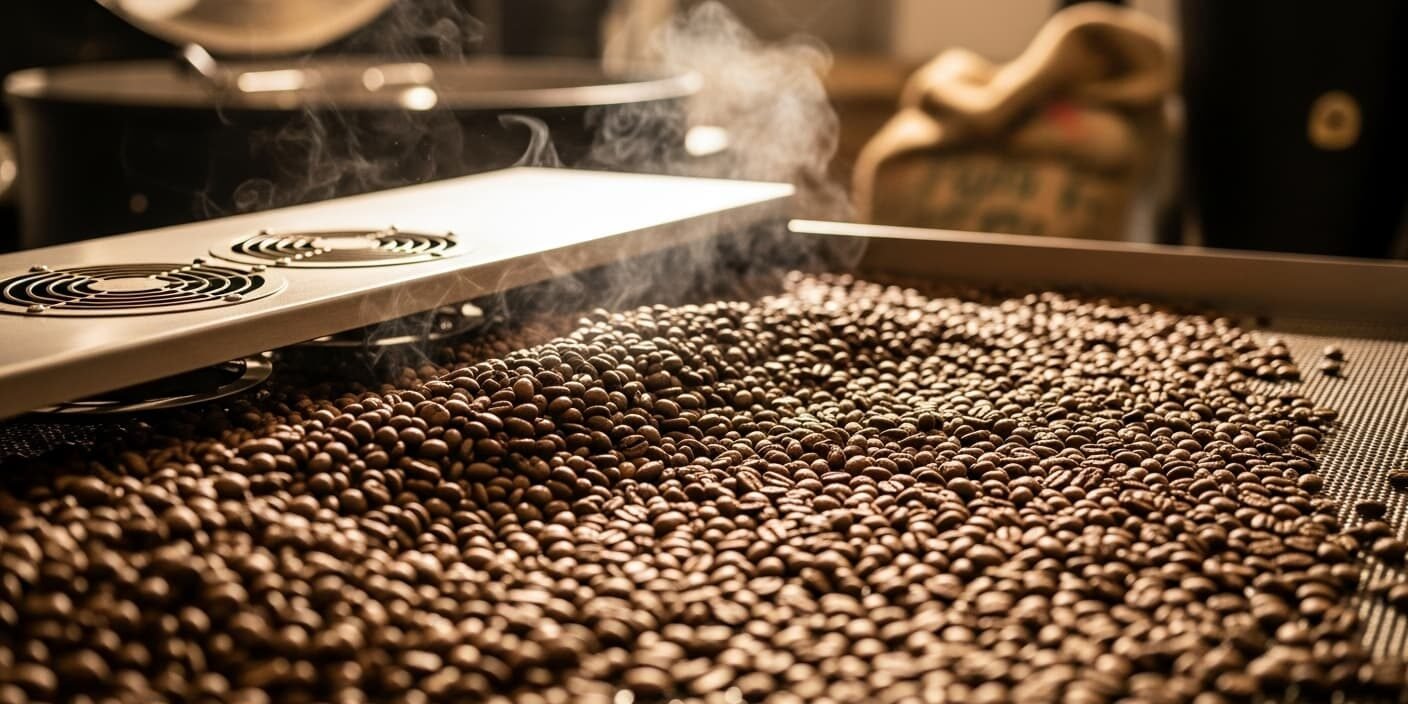
There is a stage of coffee roasting that for a long time I underestimated because it happens after the bean has already reached its target color: cooling. When I started digging deeper into the subject, I was surprised to discover that the first 3-4 minutes after taking the coffee out of the drum can be just as decisive for the final flavor as the last few minutes of roasting.
I have researched in depth the phenomenon of carryover cooking, the cooling methods used by professional roasters, and how correct or incorrect cooling management directly impacts the flavor profile. I hope this article gives you a completely new perspective on this critical stage. Let’s get started!
Understanding the coffee roasting process
Key stages of roasting in flavor development
During roasting, coffee beans go through different stages that affect their flavor profile. The Maillard reaction (between amino acids and sugars, starting at ~140°C) generates complex aromatic compounds. Caramelization (starting at ~160°C) creates sweeter, more pleasant flavors that balance acidity. There are several roast levels: light (acidity and natural flavors, green and floral notes), medium (balance between sweetness and acidity, complex nuances), and dark (robust flavors, chocolate and nut notes).
Why cooling after roasting is essential
The phenomenon of carryover cooking and its influence on the beans
Once the beans have been removed from the roasting drum, they still retain significant heat. This carryover cooking phenomenon can cause the beans to continue cooking internally, which could lead to the development of unwanted flavors. Heat retention causes an increase in chemical activity that, if not controlled, generates a bitter, burnt taste.
How cooling affects the preservation of aromas and essential oils
Cooling has a direct impact on preserving the essential oils and aromas present in the beans. A proper cooling process helps prevent flavors from fading or changing due to oxidation. Prolonged or inadequate cooling can induce rancidity, putting the coffee’s organoleptic characteristics at risk. Paying attention to the cooling phase is essential to enjoying the true potential of every cup.
Effective methods for cooling freshly roasted beans
Use of perforated trays and forced ventilation
The most common method in the industry is the use of perforated trays accompanied by a ventilation system. They allow air to circulate through the beans, facilitating rapid heat dissipation. The use of fans with forced airflow speeds up the process and prevents any risk of overcooking. This technique is essential for preserving the coffee’s organoleptic properties.
Traditional and technological alternatives in the cooling process
In more artisanal roasting environments, some use cloths or mesh screens to spread out the beans and allow the air to cool them naturally. Technology has brought options such as cooling chambers that control both temperature and humidity. Advances in sensors have also made it easier to automate this process, allowing roasters to adjust the parameters according to their specific needs.
The vital role of the first few minutes after roasting
Optimal time to reach room temperature
Ideally, the beans should be cooled to room temperature within four minutes. This ensures that the internal temperature drops effectively and prevents unwanted flavors from developing. Rapid cooling helps stop the evolution of flavors that can turn bitter, preserve essential oils and volatile compounds, and maintain the terroir, which is essential for appreciating the specific notes that characterize each origin.
Risks of slow cooling for the coffee’s profile in the cup
If the cooling process is insufficient, the following can occur: development of a bitter taste that produces an unpleasant beverage, loss of freshness and aromatic qualities, and deterioration in the physical quality of the beans that affects texture and subsequent grinding. Attention to this criterion helps ensure that every cup is a tribute to the true flavor of coffee.
How cooling influences final brewing and tasting
The temperature of the beans after cooling is vital for freshness during grinding. Well-cooled beans keep their oils and volatile compounds intact, allowing flavors to be extracted more effectively. If the beans are too hot, freshness is quickly lost due to oxidation. Rapid cooling allows the beans to preserve the desired nuances and flavors for both espresso and automatic coffee makers. Cooling is also essential in preserving terroir: properly treated beans maintain their distinctive characteristics and complex nuances that allow the origin to be appreciated.
Recommendations for coffee lovers and home roasters
Tips for roasting at home: select quality coffee beans, control the temperature with a thermometer or roaster with precise controls, watch color changes closely, and proceed to immediate cooling once the desired shade is reached. Key tools: cooling trays (they allow proper air circulation), specialized roasters (some models include automatic cooling), and digital thermometers. To identify the ideal point: know the characteristics of each type of bean and how they respond to heat, run tests in small batches, and document the process to replicate success.
Storage and subsequent handling of freshly roasted beans
Before storing the beans, it is crucial to allow them to cool completely. Inadequate cooling can lead to moisture buildup and encourage the appearance of mold. To avoid rancidity, store the coffee in an airtight container that protects it from light, air, and moisture. Use opaque containers to block light and avoid keeping the coffee near sources of heat or humidity. It is generally recommended to consume the coffee within two to three weeks after roasting to enjoy it at its best. If that is not possible, freezing the coffee in individual portions is the best option, avoiding repeated thawing and refreezing.
Frequently asked questions about cooling coffee after roasting
Why must cooling be completed in less than 4 minutes?
Because the beans come out of the drum at temperatures above 200°C and continue “cooking” internally because of the accumulated heat (carryover cooking). Every additional second at high temperature generates chemical reactions that can produce bitter, burnt, or flat flavors. The goal is to stop these reactions as soon as possible to preserve the flavors and aromas that have developed during roasting in the desired profile. Professional roasters aim to bring the bean temperature down to below 40°C within that time.
Can coffee be cooled with water to speed up the process?
It is not recommended, and in specialty coffee it is practically never done. Water adds moisture to the bean, which can create conditions favorable to mold, alter the structure of the bean, dilute the essential oils, and modify the flavor profile. Low-quality commercial coffee does use water in the cooling process (which also adds weight to the batch), but in quality coffee cooling is always done with air.
Does cooling affect coffee degassing?
Yes, indirectly. Rapid and proper cooling stabilizes the bean at the optimal roast point and promotes more orderly and predictable degassing. Degassing (the release of CO₂ that occurs in the days following roasting) is part of the coffee’s maturation process; in well-cooled coffees the process is more gradual and consistent. Poorly cooled coffee can have irregular degassing that affects brewing, especially espresso, where excess gas can hinder extraction.
How long does it take for coffee flavor to stabilize after roasting?
It depends on the type of coffee and the roast level. In general, espresso is usually at its best between 5 and 14 days after roasting, when degassing has reduced CO₂ to levels that allow clean extraction. For filter coffee, the window can be broader: from 3 days to 3 weeks. Lighter roasts usually need more resting time; darker roasts may be ready sooner. There is no universal rule: experimenting with your specific coffee is the best strategy.
Why do industrial roasters use water in cooling and artisanal roasters do not?
Industrial roasters that roast large volumes (hundreds or thousands of kilos per hour) use small amounts of water (quench) at the start of cooling because the accumulated heat is so intense that without water the carryover cooking would be excessive and the profile would deteriorate before it could be cooled with air. In addition, in the commercial coffee market the small increase in moisture (and therefore weight) can be economically advantageous. In specialty coffee and artisanal roasting, the philosophy is to maximize quality without compromising the integrity of the bean, so only air is used.
I hope this analysis of cooling after roasting has revealed the critical importance of this stage, which is often ignored. At Coffee Sapiens we never stop researching and learning about the wonderful world of coffee, so stay tuned because I’ll keep posting new content on the blog soon. Thanks for being there, Coffee Lover!
{ “@context”: “https://schema.org”, “@type”: “FAQPage”, “mainEntity”: [ { “@type”: “Question”, “name”: “Why must cooling be completed in less than 4 minutes?”, “acceptedAnswer”: { “@type”: “Answer”, “text”: “The beans come out of the drum at more than 200°C and continue cooking internally. Each additional second generates reactions that can produce bitter or flat flavors. The goal is to bring the temperature below 40°C within that time.” } }, { “@type”: “Question”, “name”: “Can coffee be cooled with water to speed up the process?”, “acceptedAnswer”: { “@type”: “Answer”, “text”: “It is not recommended in specialty coffee. Water adds moisture that can cause mold, alter the structure of the bean, and modify the flavor profile. Commercial coffee does use water, but in quality coffee air is always used.” } }, { “@type”: “Question”, “name”: “Does cooling affect coffee degassing?”, “acceptedAnswer”: { “@type”: “Answer”, “text”: “Yes, indirectly. Rapid cooling stabilizes the bean at the optimal point and promotes more orderly degassing. Poorly cooled coffee can have irregular degassing that especially affects espresso.” } }, { “@type”: “Question”, “name”: “How long does it take for coffee flavor to stabilize after roasting?”, “acceptedAnswer”: { “@type”: “Answer”, “text”: “For espresso, between 5 and 14 days after roasting. For filter coffee, from 3 days to 3 weeks. Lighter roasts need more resting time. Experimenting with each coffee is the best strategy.” } }, { “@type”: “Question”, “name”: “Why do industrial roasters use water in cooling and artisanal roasters do not?”, “acceptedAnswer”: { “@type”: “Answer”, “text”: “Industrial roasters use water because large volumes generate such intense accumulated heat that without water carryover cooking would be excessive. In specialty coffee, only air is used to maximize quality.” } } ] }

Soy Javier Romero, especialista en Marketing Digital, Coffee Lover y redactor de Coffee Sapiens.
Bienvenidos a Coffee Sapiens. Somos un medio digital independiente dedicado a la divulgación, análisis y cultura del café.