
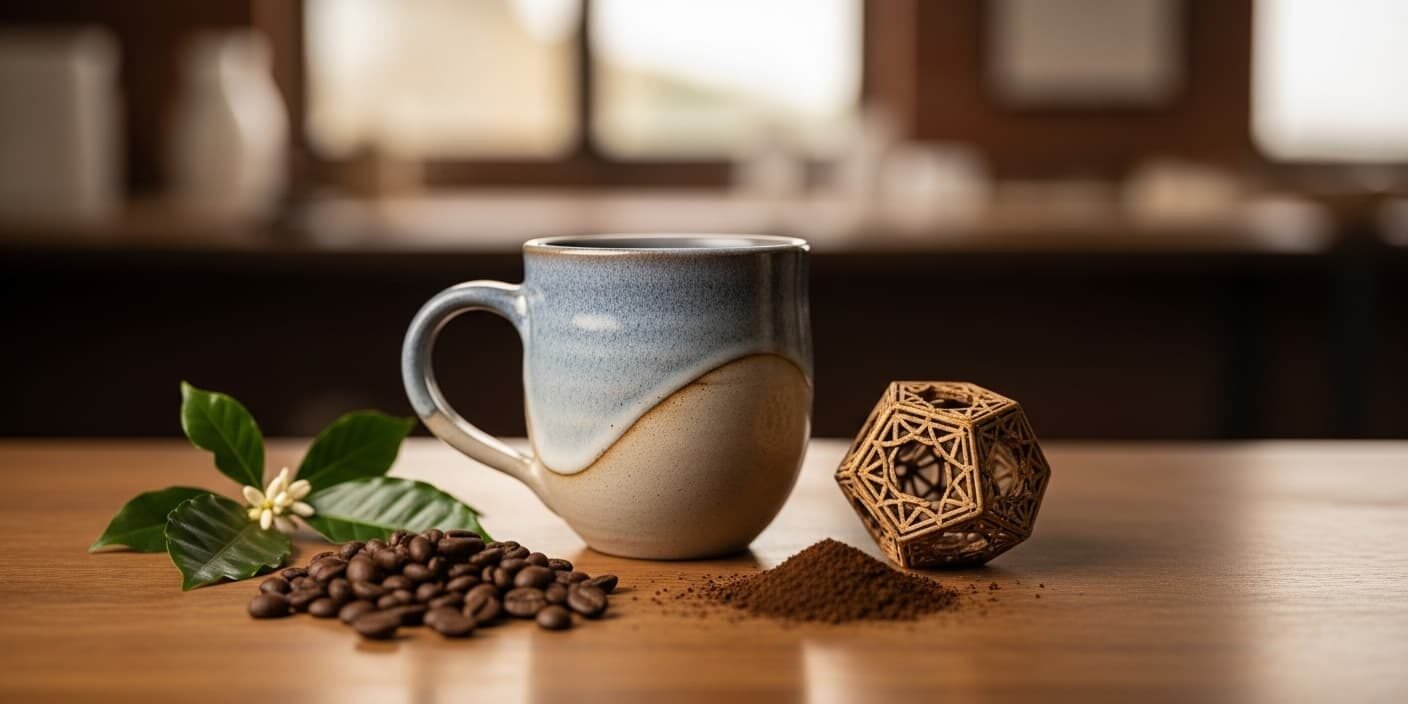
When people ask me whether I’m one of those who print in 3D, I always say no—but when I discovered that a filament made from coffee grounds existed, I felt like getting started. The idea that the waste from a cup of espresso can become material for making objects seems to me one of those intersections between coffee culture and technology that deserves in-depth research. I’ve looked into how this filament works, what properties it has, how it is printed, and what future awaits it. Let’s begin!
What coffee filament is and how it is made
Coffee filament for 3D printers is made by mixing dehydrated and processed coffee grounds with a biodegradable polymer (generally PLA) that acts as a binder. The result is a composite material that retains some of the coffee’s properties—grainy texture, natural brown color, subtle aroma during printing—while remaining compatible with standard FDM 3D printers. Companies such as 3Dom (with its Wound Up filament) and c2renew have led the development of this type of biocomposite.
Characteristics and properties of coffee filament
Coffee filament has a rougher surface texture than pure PLA, which produces finishes with a very attractive matte and organic look. During printing, it gives off a slight coffee aroma. In terms of mechanical properties, its strength is comparable to PLA but lower than ABS: suitable for decorative objects, accessories, and non-structural parts. Flexibility and thermal resistance are not its strong points either, so it is not the ideal option for functional parts subjected to mechanical stress or heat.
How to print with coffee filament
Most FDM 3D printers that process PLA are compatible with coffee filament without modifications. The recommended parameters are: extruder temperature between 200-220 °C, heated bed between 50-60 °C (if available), print speed of 30-50 mm/s, and layer height of 0.2 mm. It is important to calibrate the bed well and use adhesives or blue tape to improve first-layer adhesion. Warping can be a problem in large parts, so printing in an environment free of air drafts is recommended.
Environmental advantages and circular economy
The main appeal of coffee filament is its contribution to the circular economy. By reusing grounds that would otherwise end up in landfills—where they would decompose and emit methane—this material reduces waste and the carbon footprint associated with the production of virgin plastics. The use of PLA as a binder reinforces the product’s sustainable profile, although like any 3D printing material it still involves an industrial process with its own environmental footprint.
Creative applications and availability
Coffee filament is ideal for personalized coffee accessories (holders, dosing tools, keychains), decorative elements for the home, and educational projects on sustainability. Its price ranges between €25-35/kg, somewhat higher than conventional PLA (€15-25/kg). It can be purchased through online platforms specializing in 3D printing materials and some brick-and-mortar stores in the sector. In Spain, availability is growing, although it is still lower than that of conventional filaments.
Frequently asked questions about coffee filament
Is coffee filament compatible with any 3D printer?
With most FDM printers that process PLA, yes. It does not require special modifications such as an enclosed chamber (as ABS does). The most important thing is to set the extrusion temperature to the range recommended by the manufacturer (generally 200-220 °C) and make sure there is good bed adhesion.
Does coffee filament smell like coffee during printing?
Yes, slightly. The presence of coffee-ground particles in the filament means that during the melting process, a subtle roasted coffee aroma is released. It is one of the aspects most appreciated by users who work with this material, although the smell is neither intense nor persistent.
Is it stronger than conventional PLA?
No, it is generally comparable or slightly lower in mechanical strength. The addition of coffee grounds can introduce weak points into the filament’s structure. It is a material intended for decorative objects and accessories, not for functional parts subjected to load or impact.
Where can coffee filament be bought in Spain?
In online stores specializing in 3D printing materials such as Amazon, FiloAlfa, or European distributors such as Colorfabb. Availability in physical stores is still limited, but it is growing. Search for the terms «coffee filament» or «coffee biocomposite filament» to find available options with shipping to Spain.
What objects can be printed with coffee filament?
The best results are obtained with decorative objects (vases, bowls, figures), accessories for coffee preparation (filter holders, distribution tools), keychains, frames, and parts subject to low mechanical stress. The material’s organic texture is especially attractive in objects with a natural or handcrafted design.
At Coffee Sapiens, we never stop researching to show you how the world of coffee extends far beyond the cup. If you are passionate about sustainability and creativity, coffee filament is one of those fascinating intersections worth exploring. Thanks for being here, Coffee Lover!
{ “@context”: “https://schema.org”, “@type”: “FAQPage”, “mainEntity”: [ { “@type”: “Question”, “name”: “Is coffee filament compatible with any 3D printer?”, “acceptedAnswer”: { “@type”: “Answer”, “text”: “With most FDM printers that process PLA, yes. It does not require special modifications. The important thing is to set the extrusion temperature to the recommended range (generally 200-220 °C) and ensure good bed adhesion.” } }, { “@type”: “Question”, “name”: “Does coffee filament smell like coffee during printing?”, “acceptedAnswer”: { “@type”: “Answer”, “text”: “Yes, slightly. During the melting process, a subtle roasted coffee aroma is released. It is one of the aspects most appreciated by users, although the smell is neither intense nor persistent.” } }, { “@type”: “Question”, “name”: “Is it stronger than conventional PLA?”, “acceptedAnswer”: { “@type”: “Answer”, “text”: “No, it is generally comparable or slightly lower in mechanical strength. It is a material intended for decorative objects and accessories, not for functional parts subjected to load or impact.” } }, { “@type”: “Question”, “name”: “Where can coffee filament be bought in Spain?”, “acceptedAnswer”: { “@type”: “Answer”, “text”: “In online stores specializing in 3D printing such as Amazon or European distributors such as Colorfabb. Search for ‘coffee filament’ or ‘coffee biocomposite filament’ to find options with shipping to Spain.” } }, { “@type”: “Question”, “name”: “What objects can be printed with coffee filament?”, “acceptedAnswer”: { “@type”: “Answer”, “text”: “The best results are with decorative objects (vases, bowls), coffee accessories (filter holders), keychains, and parts subject to low mechanical stress. The material’s organic texture is especially attractive in natural or handcrafted designs.” } } ] }

Soy Javier Romero, especialista en Marketing Digital, Coffee Lover y redactor de Coffee Sapiens.
Bienvenidos a Coffee Sapiens. Somos un medio digital independiente dedicado a la divulgación, análisis y cultura del café.