
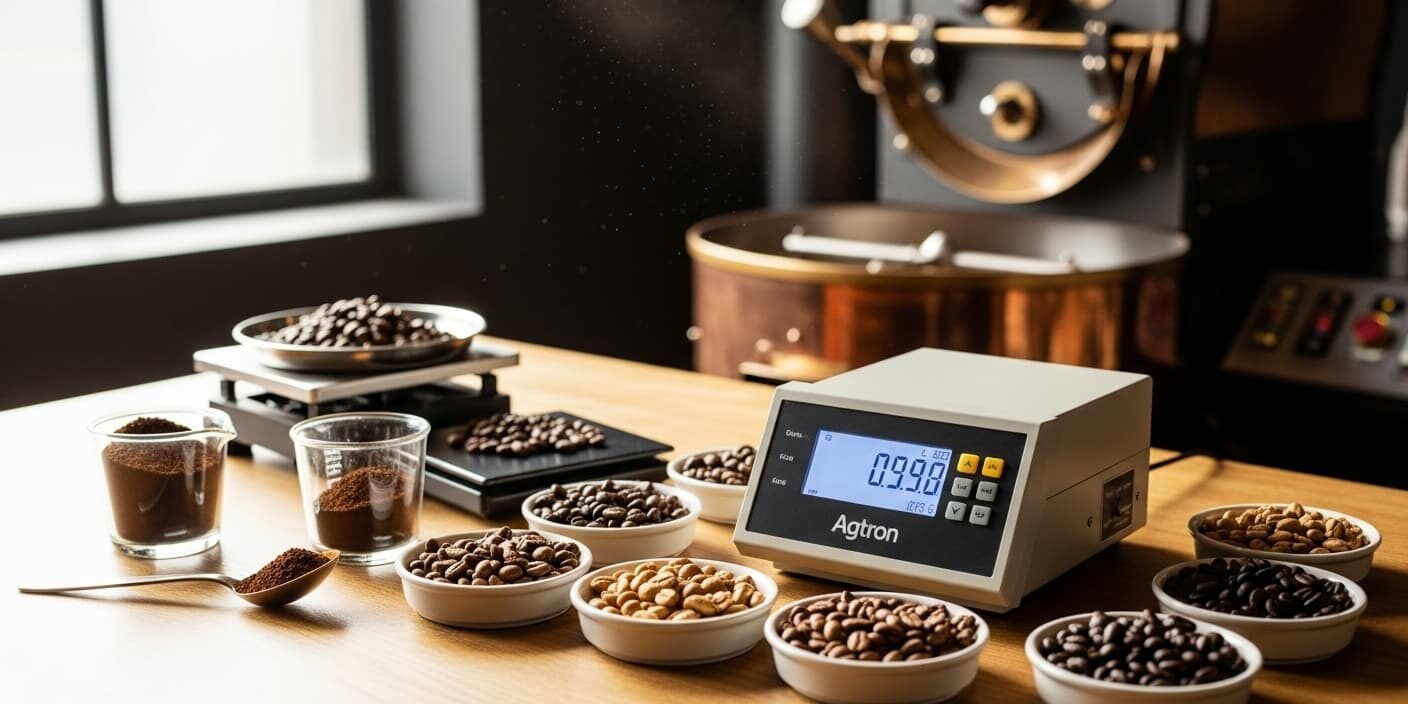
When I entered the world of specialty roasters, one of the first things that caught my attention was that small device they monitor so carefully: the Agtron colorimeter. It looked like a simple object, but the more I understood how it works and what information it provides, the clearer it became that it is one of the most powerful tools for ensuring consistency in roasting. I have thoroughly researched how the Agtron scale works, which numerical ranges correspond to each roast level, how it is measured correctly, and what implications it has for specialty coffee. I hope that after this article you will have a much more precise understanding of how roast levels are discussed in the industry. Let’s begin!
The importance of color in roasted coffee
The color of the bean is the most direct visual indicator of the roast level achieved. Lighter shades reveal greater acidity and origin notes (floral, fruity); medium roasts balance body and acidity; darker roasts emphasize caramel, chocolate, and structure. This correlation between color and sensory profile makes its objective measurement very valuable for ensuring consistency between batches.
The Agtron scale: a key tool for roasters
The Agtron colorimeter measures the reflectance of light on coffee beans using near-infrared spectroscopy. The result is a number on the Agtron scale, which goes from 0 (very dark) to 100 (very light). Each numerical range corresponds to a standard roast level: above 75 (light), 60-75 (medium-light), 45-60 (medium), 35-45 (medium-dark), below 35 (dark). This scale is the industry’s common language for communicating roast level accurately and without ambiguity.
How to measure roast level with an Agtron colorimeter
The steps are: prepare a homogeneous sample of beans at room temperature, place it over the sensor window, and obtain the reading. Periodic calibration of the device with reference discs is essential to maintain accuracy. Some roasters measure both the whole bean and the ground coffee, since the values may differ and provide complementary information about the bean’s internal development.
Benefits, challenges, and innovations in roast measurement
The main benefit is consistency: removing visual subjectivity allows different roasters or different sessions to produce comparable results. The main challenge is the bean’s natural variability: heterogeneous lots give less reliable readings. The most recent innovations include mobile apps with image analysis (ColorTrack, for example) that approximate an Agtron reading without needing the physical colorimeter, although with lower accuracy than the reference equipment.
Frequently asked questions about the Agtron colorimeter and roast measurement
How much does an Agtron colorimeter cost, and is it worth it for a micro-roastery?
The professional Agtron colorimeter (Gourmet or M-Basic model) costs between 1,000 and 4,000 euros, which puts it out of reach for many small micro-roasteries. For those who cannot afford that investment, there are more affordable alternatives: Cropster’s ColorTrack (smartphone image analysis) or the Lightells CM-100 offer approximate readings at a fraction of the cost. For a micro-roastery that sells specialty coffee in bulk or to demanding cafés, investing in a colorimeter makes sense because the customer may ask for reproducible profiles from batch to batch.
Do the Agtron readings for whole bean and ground coffee always match?
No, and the difference is informative. A bean can have a darker surface than its interior if the roast has progressed further on the outside. In that case, the Agtron number for the whole bean will be lower than that of the ground coffee. This difference, called ‘drop,’ indicates the bean’s internal development gradient. Advanced roasters record both measurements to diagnose whether development has been uniform or whether there is an imbalance between the outer layer and the interior.
Can the Agtron colorimeter be used for green coffee or only for roasted coffee?
The Agtron colorimeter is specifically designed to measure roasted coffee. For green coffee, other tools are used, such as water activity (aW) meters or moisture meters, which assess bean quality before roasting. Trying to measure green coffee with the Agtron colorimeter does not produce useful data for the roasting process.
What Agtron number is ideal for a specialty espresso?
There is no single ideal number, but the most common range in specialty coffee geared toward espresso is between 55 and 75 Agtron (medium to medium-light roast). Many third-wave roasters even work above 70 to preserve the origin’s acidity and complexity in espresso, moving away from the darker profile (35-45 Agtron) traditional in Italian espresso. The trend in the specialty segment is clearly toward lighter roasts.
Does the Agtron number appear on specialty coffee packaging?
It is still fairly uncommon, although it is gaining traction among more technical and transparent roasteries. It is more common to see the roast level described qualitatively (light, medium, dark) or with the SCA scale score. Some roasters include the Agtron number on technical sheets for B2B customers but not necessarily on consumer-facing packaging. As specialty consumers become more educated, this information is likely to be more in demand.
I hope all this information about the Agtron colorimeter and measuring roast level is useful to you, whether you are a roaster or simply want to better understand the language of specialty coffee. At Coffee Sapiens, we never stop researching and learning about the wonderful world of coffee, so stay tuned because I will keep posting new content on the blog soon. Thanks for being there, Coffee Lover!
{ “@context”: “https://schema.org”, “@type”: “FAQPage”, “mainEntity”: [ { “@type”: “Question”, “name”: “How much does an Agtron colorimeter cost, and is it worth it for a micro-roastery?”, “acceptedAnswer”: { “@type”: “Answer”, “text”: “A professional Agtron costs between 1,000 and 4,000 euros. For those who cannot afford it, there are alternatives such as ColorTrack (Cropster) or Lightells CM-100. For a micro-roastery with demanding customers who ask for reproducible profiles, the investment makes sense.” } }, { “@type”: “Question”, “name”: “Do the Agtron readings for whole bean and ground coffee always match?”, “acceptedAnswer”: { “@type”: “Answer”, “text”: “No, and the difference is informative. It is called ‘drop’ and indicates the bean’s internal development gradient. Advanced roasters record both measurements to diagnose whether development has been uniform.” } }, { “@type”: “Question”, “name”: “Can the Agtron colorimeter be used for green coffee?”, “acceptedAnswer”: { “@type”: “Answer”, “text”: “No. The Agtron colorimeter is designed for roasted coffee. For green coffee, water activity (aW) or moisture meters are used. Trying to measure green coffee with Agtron does not produce useful data.” } }, { “@type”: “Question”, “name”: “What Agtron number is ideal for a specialty espresso?”, “acceptedAnswer”: { “@type”: “Answer”, “text”: “The most common range in specialty coffee for espresso is between 55 and 75 Agtron (medium to medium-light roast). The trend in third wave is toward lighter roasts to preserve the acidity and complexity of the origin.” } }, { “@type”: “Question”, “name”: “Does the Agtron number appear on specialty coffee packaging?”, “acceptedAnswer”: { “@type”: “Answer”, “text”: “It is still uncommon on consumer-facing packaging. It is more common on B2B technical sheets. As specialty consumers become more educated, this information is likely to be more in demand.” } } ] }

Soy Javier Romero, especialista en Marketing Digital, Coffee Lover y redactor de Coffee Sapiens.
Bienvenidos a Coffee Sapiens. Somos un medio digital independiente dedicado a la divulgación, análisis y cultura del café.