
The first time I had a coffee co-fermented with passion fruit at a specialty coffee fair in Medellín, my first instinct was to think they were fooling me —that couldn’t be just coffee. It was so fruity, so exuberant, that it seemed impossible that no artificial flavoring had been added. But no: it was the result of fermenting the cherries together with the fruit pulp, letting the sugars and microorganisms from both do their work. From that moment on, I set out to thoroughly investigate this technique: how it works, which fruits are used, what results are obtained, and why it is so divisive within the specialty sector. Let’s begin!
Coffee fermentation: microorganisms and benefits
During fermentation, various microorganisms play a fundamental role in the development of coffee’s flavors and aromas. Yeasts, mainly from the genus Saccharomyces, break down the sugars present in the coffee cherry mucilage, generating alcohol and carbon dioxide. Bacteria, such as Lactobacillus, help reduce pH, promoting an environment suitable for controlled fermentation. The combined impact of these microorganisms results in a diversity of volatile compounds that directly affect the coffee’s sensory profile, generating fruity, floral, and spicy notes that increase its complexity.
Good fermentation management can enhance coffee’s natural sweetness and balance its acidity, making every sip a more harmonious experience. Natural fermentation also contributes to aromatic complexity, providing a range of nuances that make each cup unique —something especially valued in specialty coffee, where consumers are constantly looking for new and interesting experiences.
Co-fermentation process with fruit
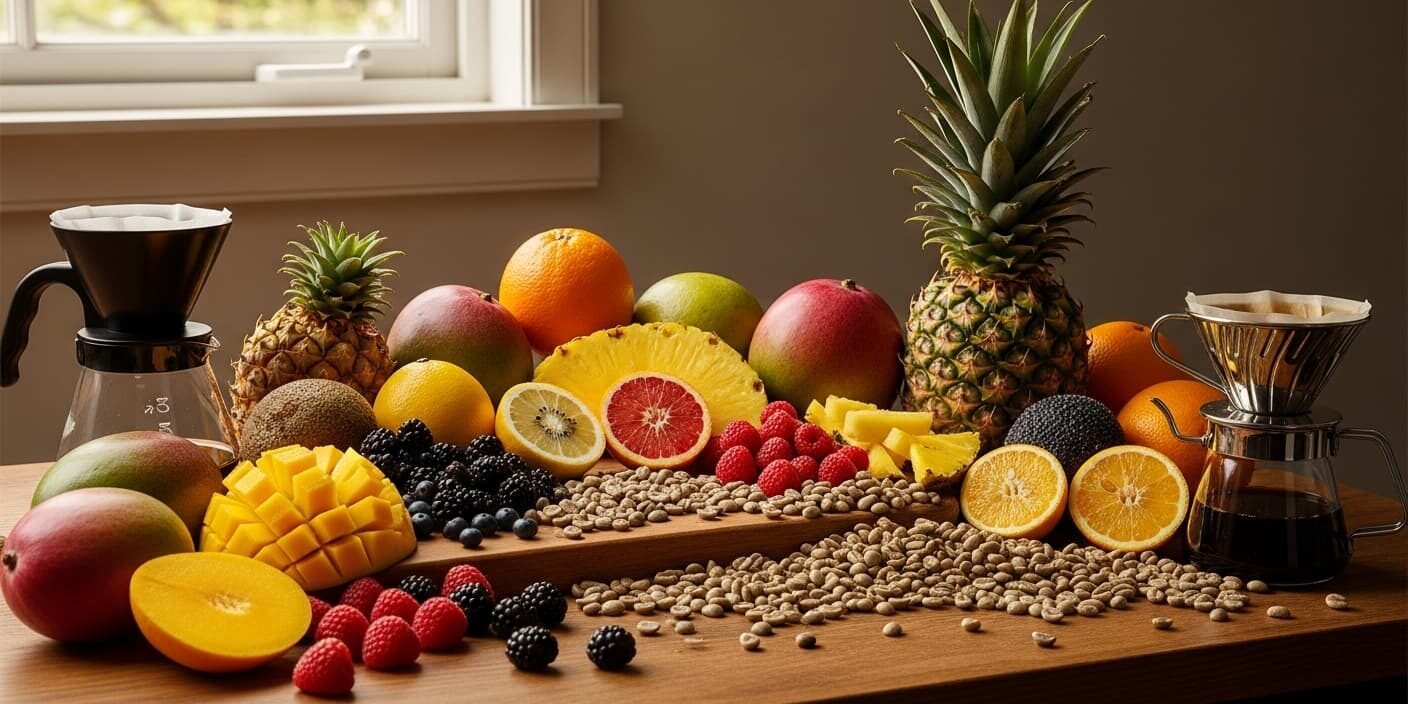
Co-fermentation is a process that transforms the coffee experience by incorporating fruit, giving rise to very distinctive flavor profiles. Properly selecting the fruit is crucial: farmers usually choose tropical fruits that provide vibrant and complex flavors, especially passion fruit, orange, pineapple, and mango. Each one interacts differently with the coffee mucilage, contributing unique profiles. It is essential that the chosen fruits be fresh and of high quality, since damaged or low-quality fruit can ruin the fermentation process; the selection of coffee cherries also requires attention, as this directly affects the final result.
The proportions of fruit and coffee vary and depend on the desired flavor profile, and the fermentation process can range from 48 to 150 hours depending on the specific conditions. Maintaining a constant temperature and an anaerobic environment —through airtight tanks— is essential to optimize fermentation, avoid unwanted flavors, and ensure a more controlled process.
Influence of each fruit on the sensory profile
Fruits not only add sweetness, but also transform the coffee’s aromatic profile. Coffees co-fermented with passion fruit can show intense tropical notes, while those with orange offer a citrus freshness that makes them stand out. Co-fermentation with mango develops a sweet, smooth flavor with honeyed touches, while pineapple brings a juicy and exotic touch. More recently, non-tropical seasonal fruits —cherries, plums, figs— are also being explored, continually enriching the range of available flavor profiles.
Notable co-fermented coffees and producer strategies
Co-fermented coffees are gaining international recognition, especially in Colombia, where coffee tradition meets innovation, taking flavor profiles to new heights. Papua New Guinea, as well as other African and Central American countries, are also experimenting with this technique, adapting it to their local fruits and growing conditions.
Post-harvest coffee management is essential to the success of the process. Having airtight tanks that ensure an anaerobic environment, along with thermometers and pH meters for precise monitoring, is essential for consistent results. Fermentation with fruit also promotes more sustainable methods by reducing dependence on chemical inputs, since the yeasts and bacteria from the fruits naturally optimize the process.
Current and future trends
Coffee lovers’ palates are shifting toward bolder experiences. Specialty coffee shops are incorporating these coffees into their menus, and tasting events are becoming a popular trend. Producers are exploring beyond traditional tropical fruits, and technology is helping as well: more precise temperature and pH control makes it possible to reproduce lots with greater consistency, something crucial if these very distinctive coffees are to scale commercially without losing quality.
Coffee Lovers’ frequently asked questions about co-fermented coffees
How does fruit influence the coffee fermentation process?
Fruits provide sugars and acids that interact with the coffee cherries during fermentation. This interaction not only modifies the composition of the mucilage, but also introduces compounds that enrich the coffee’s sensory profile. In this way, it creates more complex flavors and a more harmonious balance between acidity and sweetness.
What sensory differences does co-fermentation bring compared to traditional fermentation?
Traditional fermentation usually focuses on highlighting the coffee’s inherent characteristics, while co-fermentation introduces the complexity and diversity of fruit flavors. In general, this results in more aromatic coffees, with a notable increase in sweetness and fruity nuances, providing a unique and memorable tasting experience.
What are the best fruits to combine with coffee during fermentation?
Tropical fruits with high sugar and acid content are the most commonly used: passion fruit, orange, pineapple, and mango. Each interacts differently, allowing producers to experiment with various combinations. More recently, non-tropical seasonal fruits (cherries, plums) are also being explored with very interesting results.
Is it possible to produce co-fermented coffees outside tropical regions?
Yes, it is feasible to carry out co-fermentation in non-tropical regions, although fruit selection can be a challenge. Producers must adapt to local fruits and consider their flavor and sugar content to ensure they properly complement the coffee during fermentation. Green coffee can be imported and co-fermented at destination, although the most common practice is to do it at origin.
What are the key tips for producing a quality co-fermented coffee?
Always select fresh, top-quality fruit. Control of fermentation conditions —temperature, pH, airtightness— must be rigorous to avoid unwanted flavors. Experimenting with different proportions and fermentation times will help uncover unique combinations. And meticulous record-keeping for each lot is essential to reproduce the results when an exceptional profile is found.
At Coffee Sapiens, we never stop researching to bring you the most innovative techniques and the most surprising flavors in the coffee world. Co-fermented coffees with fruit are one of the most exciting territories in third wave coffee, and we are only just beginning to explore their possibilities. Thanks for being here, Coffee Lover!
{ “@context”: “https://schema.org”, “@type”: “FAQPage”, “mainEntity”: [ { “@type”: “Question”, “name”: “How does fruit influence the coffee fermentation process?”, “acceptedAnswer”: { “@type”: “Answer”, “text”: “Fruits provide sugars and acids that interact with the coffee cherries, modifying the composition of the mucilage and introducing compounds that enrich the sensory profile. The result is greater complexity and a more harmonious balance between acidity and sweetness.” } }, { “@type”: “Question”, “name”: “What sensory differences does co-fermentation bring compared to traditional fermentation?”, “acceptedAnswer”: { “@type”: “Answer”, “text”: “Traditional fermentation highlights the coffee’s own characteristics. Co-fermentation introduces the complexity of fruit, resulting in more aromatic coffees with greater sweetness and fruity nuances.” } }, { “@type”: “Question”, “name”: “What are the best fruits to combine with coffee during fermentation?”, “acceptedAnswer”: { “@type”: “Answer”, “text”: “The most commonly used are passion fruit, orange, pineapple, and mango because of their high sugar and acid content. Non-tropical fruits such as cherries and plums are also being explored with interesting results.” } }, { “@type”: “Question”, “name”: “Is it possible to produce co-fermented coffees outside tropical regions?”, “acceptedAnswer”: { “@type”: “Answer”, “text”: “Yes, although fruit selection can be challenging. Producers must adapt to local fruits. The most common practice is to carry out co-fermentation at origin, but it can also be done at destination with imported green coffee.” } }, { “@type”: “Question”, “name”: “What are the key tips for producing a quality co-fermented coffee?”, “acceptedAnswer”: { “@type”: “Answer”, “text”: “Select fresh, high-quality fruit, rigorously control temperature and pH, use airtight tanks for anaerobic conditions, experiment with proportions and times, and keep meticulous records for each lot.” } } ] }

Soy Javier Romero, especialista en Marketing Digital, Coffee Lover y redactor de Coffee Sapiens.
Bienvenidos a Coffee Sapiens. Somos un medio digital independiente dedicado a la divulgación, análisis y cultura del café.