
For years I used the basket that came standard with my espresso machine without questioning it. One day a barista friend let me try a shot made with a VST competition basket, and the difference was so noticeable that I was speechless. It wasn’t magic: it was geometry, tolerances, and manufacturing quality. Since then I’ve researched in depth the real differences between standard and competition baskets for espresso — what changes, why it changes, and when it’s worth investing in a better one. In this article I’ll tell you everything. Let’s get started!
What the portafilter basket is and why it matters
The portafilter basket is the perforated metal container where the ground coffee is placed for espresso extraction. Although it seems like a secondary component, it has a direct and measurable impact on espresso quality. The holes in the basket determine how water flows through the coffee bed, the pressure distribution, extraction uniformity, and ultimately the flavor in the cup. A basket with irregular perforations, inconsistent walls, or poor geometry can ruin even the best coffee and the best machine.
Key differences between standard and competition baskets
Standard baskets are the ones machine manufacturers include with their equipment. They have wider manufacturing tolerances, which means the perforations can vary slightly in diameter, distribution, and finish. This doesn’t make them bad — for casual home use they work perfectly well — but it introduces variability into the extraction.
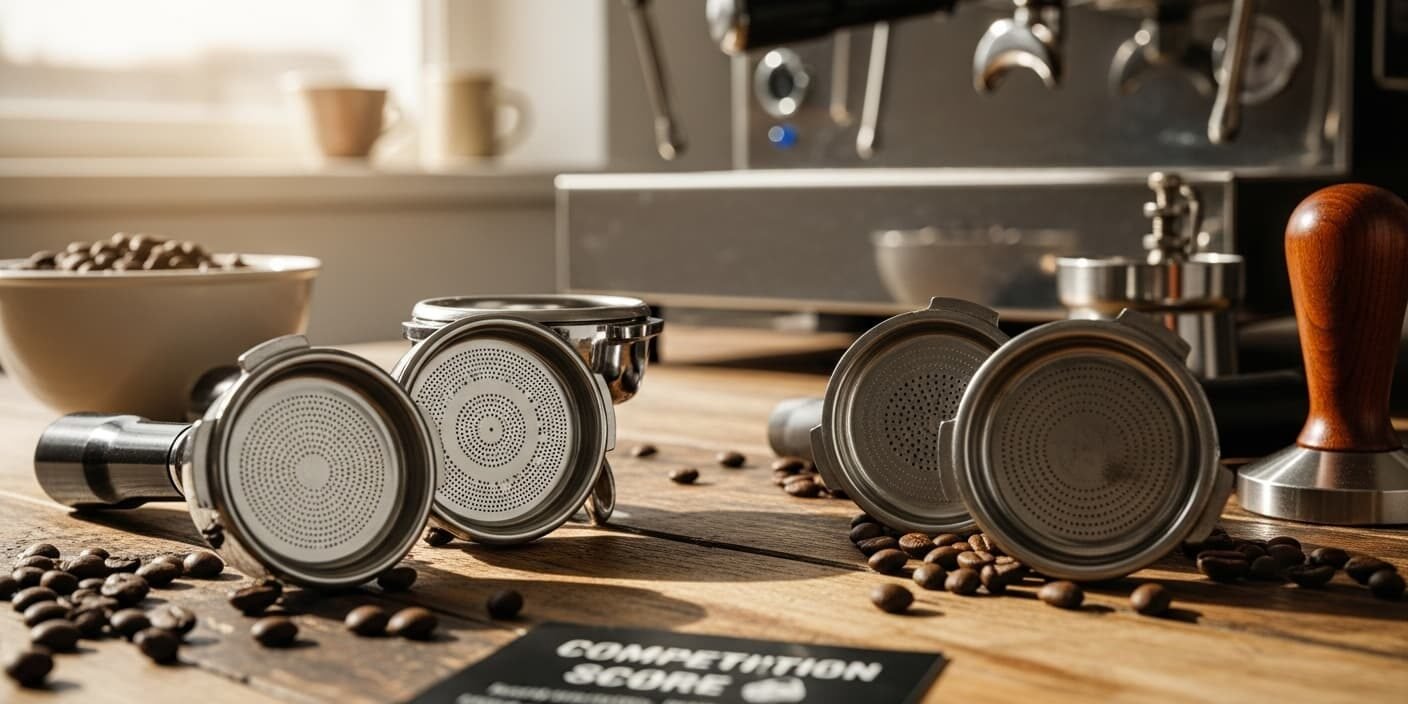
Competition baskets (such as VST, IMS, or Pullman) are manufactured with much tighter tolerances. Their distinguishing features are: more uniform perforations in diameter and distribution, more precise internal geometry (walls and base), a greater number of holes in some models (which reduces hydraulic resistance), and smoother internal finishes that facilitate even water distribution. The result is more even extraction, greater consistency between shots, and a larger margin for detecting and correcting grind variables.
Benchmark brands and models in competition baskets
VST (Vince Fedele Sproule Technologies) is the absolute benchmark in precision baskets. Made in the U.S. with tolerances of ±0.025 mm, they are the standard in international barista competitions. Available in different capacities (15, 18, 20, 22 g). IMS (Industria Meccanica Soprese) is the high-quality Italian alternative, with excellent value for money and wide availability in Spain. Pullman offers baskets with flat-bottom geometry that promotes coffee distribution and bed uniformity. Each brand has its particularities, but all of them clearly outperform standard baskets in extraction consistency.
Impact on extraction and espresso quality
Switching from a standard basket to a competition one generally produces noticeable results: greater sweetness and clarity in the flavor profile, reduced harsh bitterness caused by uneven extractions, greater consistency between shots (two consecutive extractions with the same parameters taste the same), and a greater ability to detect and correct the grind during dial-in. It’s important to note that these benefits are more noticeable when the rest of the chain (machine, grinder, water, technique) is up to the task. A competition basket won’t save a poorly ground espresso or a machine with unstable temperature.
When it’s worth changing the basket
For a home user with an entry-level machine and a basic grinder, changing the basket is not the priority: you should improve the grinder first. For a user with an already capable setup (decent boiler machine, good grinder, treated water), switching to a precision basket can be the highest-impact upgrade at the lowest cost — an IMS or VST basket costs between 30 and 60 euros. For professional baristas and competitors, competition baskets are simply the minimum standard: they provide the consistency needed to work at a high level.
Compatibility and practical considerations
Before buying a competition basket, check compatibility with your portafilter: the standard 58 mm diameter is the most common (Breville, La Marzocco, ECM, Rocket…) but there are 54 mm portafilters (some Breville Barista Express models) and 57 mm ones. VST and IMS baskets are available in the most common capacities (14-22 g), so choose according to your usual dose. Keep in mind that precision baskets may require a slightly different grind adjustment than your standard basket when you first use them, which is normal — you just need to dial in with the new basket.
Frequently asked questions about competition vs standard baskets for espresso
Can you really notice the difference between a standard basket and a VST or IMS?
Yes, especially in terms of consistency and flavor clarity. The most noticeable improvement is not always in the first shot, but in reproducibility: two consecutive extractions with the same parameters taste the same with a precision basket, whereas with a standard one there may be variability. You also get greater sweetness and less harsh bitterness in medium- to high-quality coffees.
What dose size should I buy the basket for?
Choose the capacity that matches your usual working dose. The general rule is that the coffee should sit 1-2 mm below the rim of the portafilter after tamping. If you normally use 18 g, an 18 g VST or IMS basket is the right choice. Avoid using a 20 g basket with 15 g of coffee or vice versa — the bed will sit too high or too low and extraction will be compromised.
Are VST baskets compatible with any machine?
With any machine that has a 58 mm portafilter, yes. That includes the vast majority of prosumer and professional machines on the market. For other diameters (54 mm, 57 mm), there are IMS options, although with less variety. Always check your portafilter diameter before buying.
How much does a competition basket cost and where can you buy one?
IMS baskets cost between 25 and 45 euros; VST baskets between 40 and 65 euros. They can be bought from specialized coffee shops in Spain, on the manufacturers’ official websites, or on platforms such as Amazon. It is one of the best value-for-money upgrades in an espresso setup.
Do I need to change anything else when I change baskets?
Only the dial-in. When you start using a competition basket, pull a few adjustment shots to find the optimal grind setting with the new basket — you may need to go slightly finer or coarser than with your previous basket. Also make sure your tamper has the correct diameter for the new basket (normally 58.35 mm for 58 mm baskets).
At Coffee Sapiens, we never stop researching to help you get the most out of your coffee equipment. Changing the portafilter basket is one of those small, affordable upgrades that can make a real difference in your cup. Thanks for being there, Coffee Lover!
{ “@context”: “https://schema.org”, “@type”: “FAQPage”, “mainEntity”: [ { “@type”: “Question”, “name”: “Can you really notice the difference between a standard basket and a VST or IMS?”, “acceptedAnswer”: { “@type”: “Answer”, “text”: “Yes, especially in consistency and flavor clarity. The most noticeable improvement is reproducibility: two consecutive extractions with the same parameters taste the same with a precision basket. You also get greater sweetness and less harsh bitterness in medium- to high-quality coffees.” } }, { “@type”: “Question”, “name”: “What dose size should I buy the basket for?”, “acceptedAnswer”: { “@type”: “Answer”, “text”: “Choose the capacity that matches your usual working dose. The coffee should sit 1-2 mm below the rim after tamping. If you normally use 18 g, an 18 g basket is the right choice. Avoid using a basket with a capacity very different from your actual dose.” } }, { “@type”: “Question”, “name”: “Are VST baskets compatible with any machine?”, “acceptedAnswer”: { “@type”: “Answer”, “text”: “With any machine that has a 58 mm portafilter, yes. That includes the vast majority of prosumer and professional machines. For other diameters, there are IMS options, although with less variety.” } }, { “@type”: “Question”, “name”: “How much does a competition basket cost and where can you buy one?”, “acceptedAnswer”: { “@type”: “Answer”, “text”: “IMS baskets cost between 25 and 45 euros; VST baskets between 40 and 65 euros. They can be purchased from specialized coffee shops, on the manufacturers’ official websites, or on Amazon. It is one of the best value-for-money upgrades in an espresso setup.” } }, { “@type”: “Question”, “name”: “Do I need to change anything else when I change baskets?”, “acceptedAnswer”: { “@type”: “Answer”, “text”: “Only the dial-in. When you start using a competition basket, pull a few adjustment shots to find the optimal grind setting. You may need to make the grind slightly finer or coarser and make sure your tamper diameter is correct for the new basket.” } } ] }

Soy Javier Romero, especialista en Marketing Digital, Coffee Lover y redactor de Coffee Sapiens.
Bienvenidos a Coffee Sapiens. Somos un medio digital independiente dedicado a la divulgación, análisis y cultura del café.