
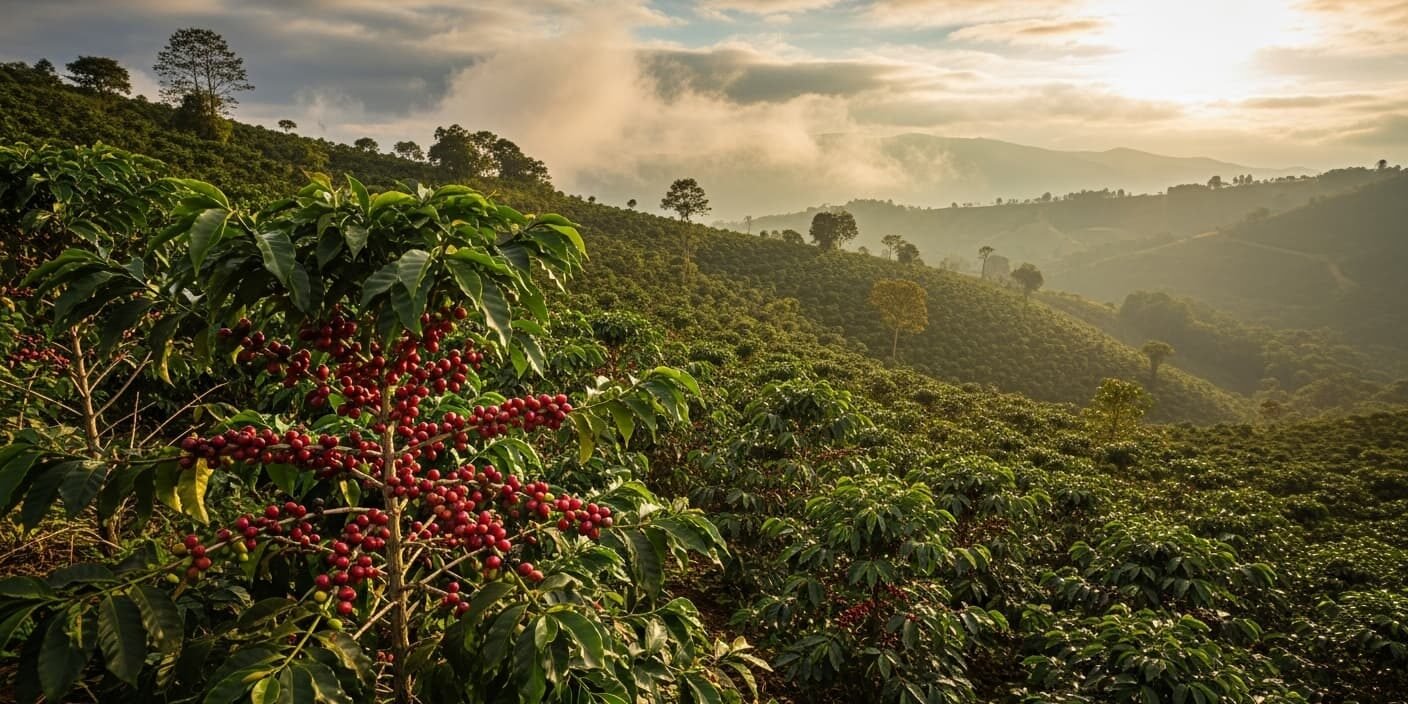
When I started researching the Castillo variety of Colombian coffee, I came across one of the most fascinating—and polarized—debates in the world of specialty coffee. On the one hand, a variety created with scientific precision by Cenicafé to save Colombian coffee farms from leaf rust. On the other, widespread criticism that its cup profile does not reach the complexity of historic varieties such as Caturra or Typica, which it displaced. Who is right? As often happens, the answer lies in the nuances.
I have researched the origin of Castillo, its genetic design, why it generated so much controversy in the specialty coffee world, and what the current evidence tells us about its cup quality. I hope this article gives you a more complete view of a variety that, whether you like it or not, dominates the Colombian coffee landscape. Let’s get started!
Origin and development of Castillo by Cenicafé
Castillo is a Coffea arabica variety developed by the National Coffee Research Center (Cenicafé) in Colombia, the result of a breeding program that goes back several decades and culminated in its official release in 2005. Its name honors researcher Jaime Castillo Zapata, one of the architects of the program. The context of its development is key to understanding the variety: Colombia was facing a devastating epidemic of coffee leaf rust (Hemileia vastatrix), the fungus that ravaged coffee farms throughout Central and South America. Cenicafé’s objective was to create a variety that combined genetic resistance to leaf rust with high productivity and acceptable cup quality, allowing Colombian coffee growers to continue producing profitably without depending on costly chemical control of the disease.
Agronomic characteristics of Castillo
Genetically, Castillo is a complex hybrid that incorporates genes from Timor Hybrid—a natural cross between Coffea arabica and Coffea canephora that carries leaf-rust resistance—crossed with high-yield, short-stature varieties such as Caturra. This robusta genetic inheritance (Coffea canephora) in Timor Hybrid is precisely the core of the debate over its cup profile. In agronomic terms, its advantages are clear: excellent resistance to multiple races of leaf rust, high yield per plant, a short stature that facilitates harvesting, and good adaptation to different altitudes and management conditions. Cenicafé also developed different Castillo lines (Castillo General, Castillo Naranjal, Castillo El Tambo…) specifically adapted to the conditions of different Colombian coffee-growing regions.
The controversy over its cup profile
The massive adoption of Castillo—driven by the National Federation of Coffee Growers and by coffee growers’ need to combat leaf rust—generated a significant critical reaction in the specialty coffee sector. Many roasters and international buyers argued that Castillo produced coffees with a flatter profile, less aromatic complexity, and less vibrant acidity than historic varieties such as Caturra, Typica, or Bourbon, which it had displaced. The presence of Timor Hybrid genes (with robusta genetic background) was identified as the possible cause of this loss of complexity. However, comparative studies carried out by Cenicafé itself and by third parties showed that the differences in cup quality between Castillo and Caturra, when grown at similar altitudes with the same post-harvest management, are statistically small or inconclusive. The debate also reveals a real bias in the sector: Castillo was widely grown at lower altitudes and with more extensive management, which may have biased the comparisons unfavorably relative to varieties grown under more demanding specialty conditions.
Castillo in today’s specialty market
Today, Castillo represents a very significant share of Colombian coffee production—it is estimated that in some years it has accounted for more than 40% of the national harvest—which means that many of the Colombian coffees sold as “specialty” are or contain Castillo. Better-informed buyers no longer reject Castillo automatically, but instead evaluate each lot according to its growing altitude, processing, and harvest: a Castillo well grown at more than 1,600–1,800 meters above sea level, with careful washed processing and selective picking, can obtain SCA scores above 86–87 points, placing it clearly in the specialty range. Some specialized farms are working specifically with Castillo as a quality variety, with results that challenge the historic criticism.
What future awaits the Castillo variety
With climate change pushing viable altitudes for high-quality arabica coffee upward and leaf rust becoming increasingly aggressive in warmer conditions, resistant varieties such as Castillo are gaining strategic relevance that goes beyond the current quality debate. Cenicafé continues improving the program, and research into new lines seeks to maintain resistance while broadening and refining the sensory profile. The real debate still pending in the sector is how much of Castillo’s supposed inferiority is due to its genetics and how much to the growing conditions under which it has generally been managed: if the answer is “mostly the growing conditions,” Castillo has far more potential as a specialty variety than the market has recognized so far.
Frequently asked questions about the Castillo variety in Colombia
Why did Cenicafé develop the Castillo variety?
To give Colombian coffee growers a variety genetically resistant to coffee leaf rust (Hemileia vastatrix), which had devastated coffee farms across the Americas. The goal was to combine durable resistance to multiple races of the fungus with high productivity and acceptable cup quality, reducing dependence on costly chemical control.
Does Castillo have robusta genes, and does that affect its quality?
Yes, Castillo incorporates genes from Timor Hybrid, which is a natural cross of arabica and robusta. Those robusta genes are what confer resistance to leaf rust, but they are also at the center of the quality debate: some argue that they reduce aromatic complexity. However, comparative studies show that when Castillo is grown at altitudes and under conditions similar to other arabica varieties, the differences are small and not always statistically significant.
Can a Castillo-variety coffee be specialty coffee?
Yes, absolutely. A Castillo grown above 1,600 meters with selective picking and careful washed processing can obtain SCA scores clearly within the specialty range (85+ points). Some specialized Colombian farms work with Castillo as a quality variety, with results that challenge the sector’s historic skepticism.
How do I identify whether the Colombian coffee I buy is Castillo?
Specialty roasters with origin transparency usually specify the variety on the label. If it only says “Colombia” or “Colombian arabica” without further detail, it probably contains Castillo—given its prevalence—but there is no way to know for sure. For buyers who value the specific variety, the best option is to purchase coffees from farms that detail variety, altitude, and processing.
What other leaf-rust-resistant varieties exist in Colombia?
Cenicafé has also developed the Cenicafé 1 variety (with a different genetic architecture of resistance) and continues researching new lines. In the broader regional context, Colombia also has producers working with Tabi (a cross of Timor, Typica, and Bourbon), which has greater acceptance in the specialty market because of its more complex profile. The debate over resistance versus quality is a challenge the entire global coffee industry faces in the context of climate change.
I hope this journey through the Castillo variety has given you a more nuanced perspective on one of the most important—and most debated—varieties in Colombian coffee. At Coffee Sapiens we never stop researching and learning about the wonderful world of coffee, so stay tuned because I’ll soon keep posting updates on the blog. Thanks for being there, Coffee Lover!
{ “@context”: “https://schema.org”, “@type”: “FAQPage”, “mainEntity”: [ { “@type”: “Question”, “name”: “Why did Cenicafé develop the Castillo variety?”, “acceptedAnswer”: { “@type”: “Answer”, “text”: “To provide genetic resistance to coffee leaf rust, combining durable resistance with high productivity and acceptable cup quality, reducing dependence on costly chemical control.” } }, { “@type”: “Question”, “name”: “Does Castillo have robusta genes, and does that affect its quality?”, “acceptedAnswer”: { “@type”: “Answer”, “text”: “Yes, it incorporates genes from Timor Hybrid (a natural arabica-robusta cross) that confer resistance. Studies show that under conditions similar to other arabica varieties, the quality differences are small and not always statistically significant.” } }, { “@type”: “Question”, “name”: “Can a Castillo-variety coffee be specialty coffee?”, “acceptedAnswer”: { “@type”: “Answer”, “text”: “Yes. A Castillo grown above 1,600 meters with selective picking and good processing can obtain SCA scores clearly within the specialty range.” } }, { “@type”: “Question”, “name”: “How do I identify whether the Colombian coffee I buy is Castillo?”, “acceptedAnswer”: { “@type”: “Answer”, “text”: “Roasters with origin transparency usually specify the variety. If it only says ‘Colombia’ without further detail, it probably contains Castillo given its prevalence, but there is no way to know for sure.” } }, { “@type”: “Question”, “name”: “What other leaf-rust-resistant varieties exist in Colombia?”, “acceptedAnswer”: { “@type”: “Answer”, “text”: “Cenicafé also developed the Cenicafé 1 variety. The Tabi variety (a cross of Timor, Typica, and Bourbon) has greater acceptance in the specialty market because of its more complex profile.” } } ] }
Soy Javier Romero, especialista en Marketing Digital, Coffee Lover y redactor de Coffee Sapiens.
Bienvenidos a Coffee Sapiens. Somos un medio digital independiente dedicado a la divulgación, análisis y cultura del café.