
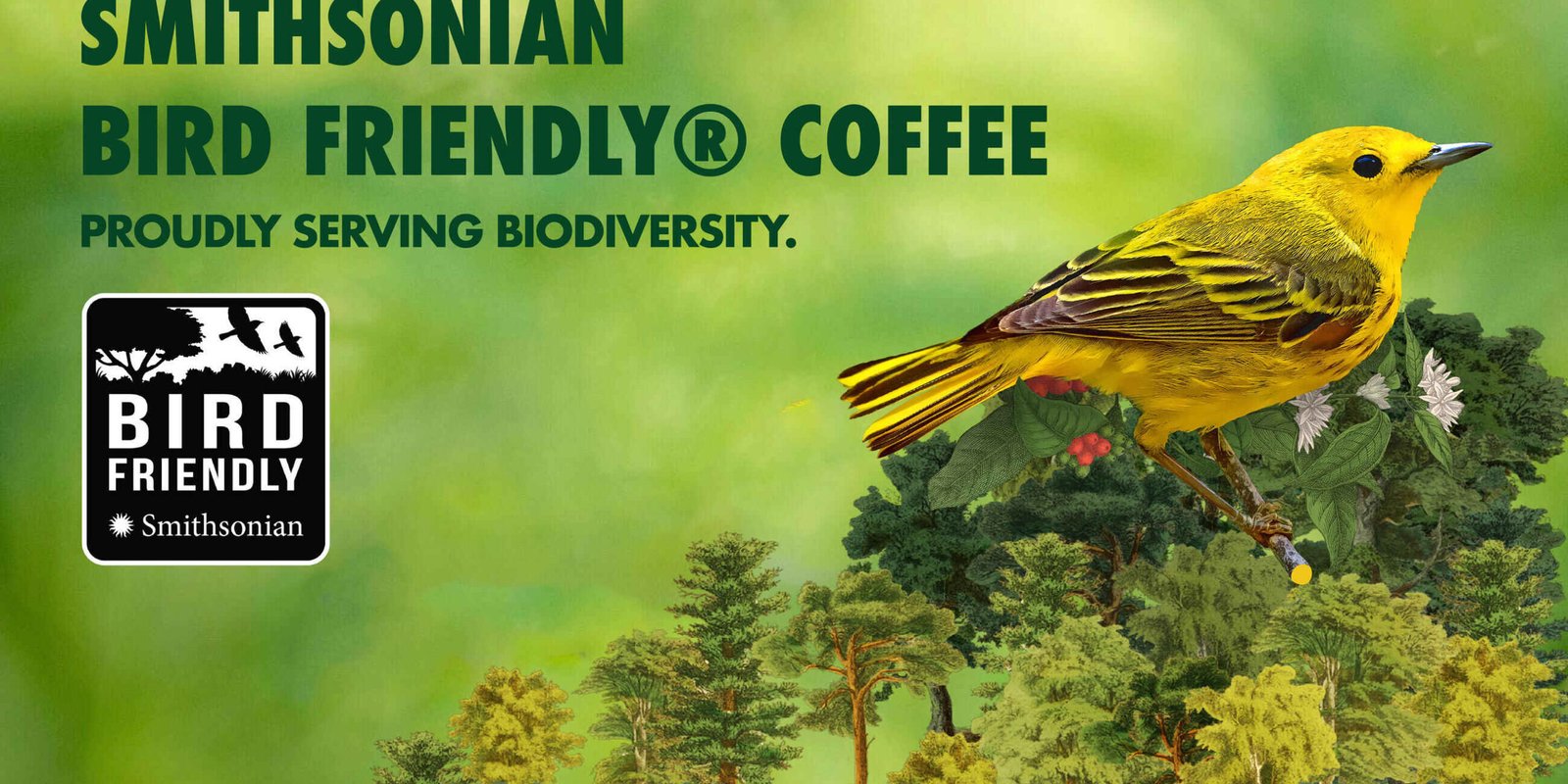
The Bird Friendly Seal is a certification that promotes sustainable agriculture, especially in coffee and cocoa production. Its main objective is to protect migratory birds and their habitats through responsible agricultural practices.
Since its creation at the Smithsonian Migratory Bird Center, this seal has evolved and become a benchmark in the sector. Throughout this article, its origins, requirements, and its impact on the market, among other aspects, will be explored.
Origins and development of the Bird Friendly program
The history of the Bird Friendly program is rich and transformative, forging a path toward sustainable agriculture with a strong focus on biodiversity conservation and the protection of migratory birds.
Founding at the Smithsonian Migratory Bird Center
The program was born in 1987 within the Smithsonian Migratory Bird Center, thanks to the vision of ornithologist Russell Greenberg. His work in Panama revealed the urgent need to protect migratory bird habitats through agricultural practices that, at the same time, benefited local producers.
Evolution to the current certification
Since its creation, the program has evolved. In 1996, the certification was formalized, marking a significant milestone in the coffee and cocoa industry. This development has influenced cultivation practices, integrating ecological and social criteria that have forged a rigorous standard to ensure the quality and sustainability of products.
Relationship with migratory bird conservation
The program’s approach is deeply connected to the conservation of migratory birds. By promoting cultivation that respects the environment and includes tree cover and diversity, safe habitats for these species are guaranteed. This not only contributes to biodiversity, but also establishes a healthy ecological balance.
Requirements and standards of the Bird Friendly seal
The Bird Friendly seal is governed by strict standards that ensure sustainability and the conservation of critical habitats for migratory birds. The fundamental requirements that crops must meet to obtain this certification are detailed below.
Organic farming and ecological certification
Bird Friendly certification requires all crops to be organic, which implies an unwavering commitment to the health of the environment and of those who consume these products.
Ban on synthetic pesticides and fertilizers
One of the seal’s distinctive features is the prohibition on using synthetic chemical pesticides and fertilizers. This approach protects soil quality and the biodiversity of the agricultural environment.
Environmental and health benefits
Organic farming promotes healthier soils, improves water quality, and contributes to the conservation of local ecosystems. In turn, the resulting products are more beneficial to consumer health by avoiding chemical residues.
Shade-grown cultivation and agroforestry systems
The shade-grown cultivation system is fundamental to Bird Friendly certification, as it creates a suitable environment for both coffee and cocoa as well as for birds and other at-risk organisms.
Importance of the tree canopy
The tree canopy not only provides shade for the plants, but also acts as an essential habitat for various bird species, which are vital to ecological balance.
Diversity of tree species
Plantations must maintain a diversity of at least ten tree species per hectare. This diversity is crucial for limiting soil erosion and fostering a more resilient ecosystem.
Conservation of habitats and forests
Forest protection is a key principle in obtaining Bird Friendly certification. This ensures that ecosystems and migratory birds are properly safeguarded.
Forest reserves and protected areas
Farmers must reserve 40% of their land as forest or a protected area, contributing to the conservation of natural habitats.
Standards against recent deforestation
It is imperative that there have been no deforestation practices or conversion of forests to agriculture in the last ten years, reinforcing the commitment to sustainability.
Ecological and social impact of the certification
Bird Friendly certification has a considerable impact on environmental conservation and on improving the quality of life of those who grow coffee and cocoa. This certification not only protects ecosystems, but also provides significant economic benefits to producers.
Conservation of biodiversity and bird species
Protection of migratory bird habitats
One of the fundamental pillars of this certification is the protection of critical habitats for migratory birds. By encouraging agricultural practices that promote shade-grown cultivation, a natural environment is guaranteed that not only preserves bird species, but also helps maintain the region’s overall biodiversity. This contributes to an ecological balance in which birds can migrate without putting their habitat at risk.
Associated ecosystem services
The benefits of this approach go beyond simple conservation. Important ecosystem services are generated that affect agriculture and the natural environment. Among them are:
- Pollination of crops, which improves agricultural production.
- Natural pest control, reducing the need for pesticides.
- Improved soil health, thanks to the diversity of tree species.
Benefits for coffee and cocoa producers
Improved livelihoods and higher prices
The implementation of sustainable practices has allowed farmers who obtain this certification to access markets that value quality coffee and cocoa. As a result, the prices they receive for their product are considerably higher, which improves their livelihoods and provides them with greater economic stability.
Adoption of sustainable and ecological practices
Producers also adopt a more responsible approach toward the environment, integrating ecological farming practices that promote conservation. This not only benefits local flora and fauna, but also positions farmers as leaders in the transition toward a more sustainable agricultural model that is more respectful of nature.
Bird Friendly in the sustainable coffee and cocoa market
The Bird Friendly Seal has established itself as a prominent option in the sustainable coffee and cocoa industry, driven by growing concern for conservation and responsible consumption.
Growth and presence in international markets
Interest in products that meet Bird Friendly standards has experienced notable growth in recent years. Consumers are increasingly aware of the benefits they bring to sustainability and biodiversity.
Expansion in the European market
In Europe, the seal has found fertile ground for its expansion. With a population that values sustainability, certified products are gaining ground in stores and coffee shops. This phenomenon encourages producers to adopt more responsible practices.
Growing demand for certified products
The growing demand for certified coffee and cocoa is driven by greater education about the importance of sustainable agriculture. Consumers are increasingly seeking options that are not only tasty, but also aligned with their environmental values.
Comparison with other ecological and social certifications
When analyzing the certification landscape, it is crucial to understand how Bird Friendly differs from other accreditations that also promote sustainability, although with varied approaches.
Differences with Fair Trade and Rainforest Alliance
- Fair Trade: It focuses on obtaining fair prices for producers, but does not necessarily consider biodiversity.
- Rainforest Alliance: It combines social and conservation criteria, although it does not always encompass Bird Friendly’s ecological depth.
Advantages over organic and Shade-grown certifications
- Organic certifications: They focus on the prohibition of pesticides, but Bird Friendly adds a commitment to habitat conservation.
- Shade-grown: Although it shares the idea of shade-grown cultivation, Bird Friendly imposes more rigorous requirements regarding tree diversity and agricultural practices.
The consumer experience and coffee quality
Coffee quality has a direct impact on the experience enthusiasts enjoy. By choosing products with the Bird Friendly seal, not only is a commitment to sustainability guaranteed, but also an exceptional flavor offering. The production processes that comply with these strict standards are the core of the coffee’s sensory experience.
How to recognize products with the Bird Friendly seal
Identifying a coffee that has Bird Friendly certification is easy. Consumers should pay attention to the labels on the packaging. The following points are key:
- Look for the Bird Friendly logo on the packaging.
- Read the product description, which should mention its sustainable origin.
- Verify the connection with the producer or certified farms.
Influence on the flavor and quality of cultivated coffee
When coffee is grown under strict sustainable standards, the characteristics that develop in the bean are noticeably better. The quality of fresh coffee is influenced by various factors such as:
Characteristics of certified specialty coffee
This type of coffee, which comes from responsible practices, is appreciated for its refined flavor profile. Among its standout characteristics are:
- Complexity of flavors.
- Unique aromatic notes.
- Balanced acidity that highlights freshness.
Impact of sustainable cultivation on the final product
Cultivation that respects the environment and biodiversity has a direct effect on coffee quality. Sustainable methods guarantee:
- More careful and selective harvesting.
- More uniform, higher-quality beans.
- Reduction of contaminants, which improves the overall perception of the coffee.
Challenges and opportunities for the future of the seal
The future of the Bird Friendly Seal faces both significant challenges and exciting possibilities on its path toward sustainability.
Environmental threats and climate change
Environmental threats represent a critical challenge for the certification. Climate change has altered cultivation patterns and affected natural habitats. Extreme droughts and intense rainfall impact coffee and cocoa production, complicating producers’ lives. This may lead to a reduction in the amount of certified products available on the market.
Promotion of awareness and environmental education
Public awareness is essential to boost the growth of the seal. Increasing knowledge about the importance of the Bird Friendly Seal can help connect consumers with the cause of conservation.
Awareness among coffee lovers and consumers
The role of coffee lovers is vital. Through informational campaigns and workshops, the connection between responsible consumption and biodiversity can be strengthened. Involving consumers in the sustainable production process fuels their interest and commitment.
Boosting the adoption of responsible practices in the supply chain
Promoting the adoption of responsible practices throughout the supply chain is also essential. Encouraging producers to adopt sustainable methods can foster a more supportive and fertile environment for certification. Support programs for farmers and workshops on sustainable cultivation techniques can be key tools to drive this transition.

Soy Javier Romero, especialista en Marketing Digital, Coffee Lover y redactor de Coffee Sapiens.
Bienvenidos a Coffee Sapiens. Somos un medio digital independiente dedicado a la divulgación, análisis y cultura del café.