
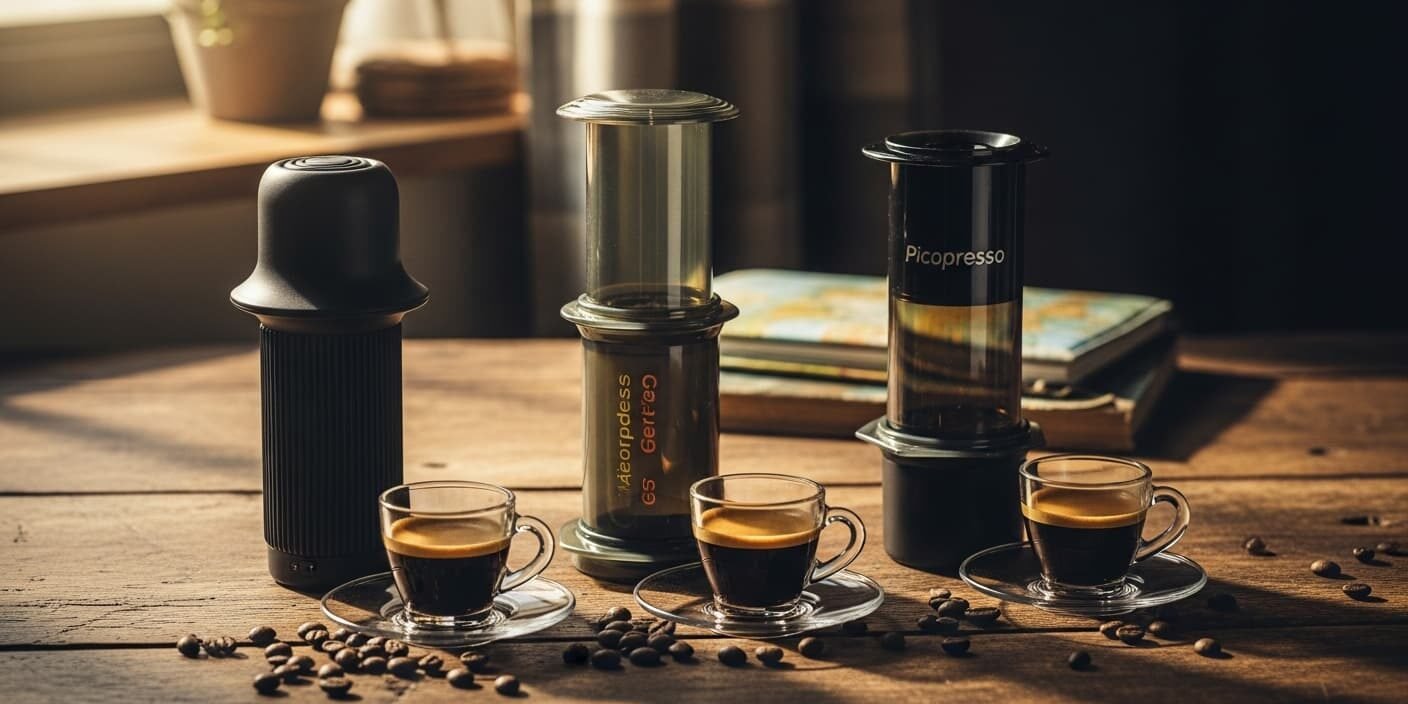
I’m the kind of person who always carries coffee with me when I travel. I started with the original AeroPress, then discovered the Nanopresso on a mountain trip, and some time ago I got a Picopresso to see firsthand the real difference between the three. Today I want to share that comparison in the most honest and practical way possible, because they are three very different options that suit very different types of travelers.
I’ve taken an in-depth look at performance, portability, coffee quality, and the situations in which each one shines. I hope that by the end of this article you’ll have a very clear idea of which one is right for you. Let’s get started!
Nanopresso: the most compact for high-pressure espresso
The Wacaco Nanopresso is the smallest and lightest manual espresso maker of the three: it weighs around 180 g and fits in a jacket pocket. It works through a manual pumping system that can reach up to 18 bars of pressure, which allows it to produce a real espresso —with crema included— without the need for electricity, just hot water. The process requires repeatedly pumping the lever until the coffee comes out through the filter, which takes a bit of practice to do easily, but once mastered it is quick and satisfying. The portafilter is small (it holds about 8 g of finely ground coffee), which limits the cup size to an espresso or ristretto. Optional accessories can be purchased (such as the NS Barista Kit, which adds compatibility with Nespresso capsules and increases the portafilter capacity). Its biggest advantage is its size-to-power ratio; its main limitation is that each brew is only for one small cup.
AeroPress Go: the most versatile and easiest to use
The AeroPress Go is the travel version of the original AeroPress, specifically designed to be more compact and to include a cup that doubles as a storage case. Its operation is the simplest of the three: ground coffee, hot water, wait between 1 and 4 minutes depending on the recipe, and press the plunger. It does not generate the pressure of a real espresso (it works at 0.35-0.75 bars, not 9+), but it can produce a concentrated coffee that some call “espresso style,” although technically it isn’t. Its great strength is versatility: with the same coffee maker you can make a short concentrated shot, an Americano, a cold brew (with cold water), or an inverted filter coffee. It accepts any grind size from very fine to very coarse, and the paper filters (round, easy to find or carry as spares) give a very clean cup. It is the easiest of the three to clean —one push of the plunger ejects the spent coffee in one compact puck— and the most forgiving of mistakes. Ideal for anyone who values versatility and simplicity over espresso purity.
Picopresso: the most demanding, but the one that produces the best espresso
The Picopresso, also from Wacaco, is the bigger sister of the Nanopresso and is designed specifically for those who want real quality espresso in a portable format. Unlike the Nanopresso, the Picopresso has a standard-size portafilter (18 g of coffee) and a double-wall pumping system similar to that of professional espresso machines, capable of maintaining more consistent pressure during extraction. The result in the cup is noticeably better in terms of complexity, crema, and body. It is somewhat larger than the Nanopresso (150 × 70 mm vs 103 × 65 mm) and takes more practice to master: tamping in the small portafilter requires precision, and the grind must be quite fine and consistent to get the right pressure. If you’re willing to invest time in learning to use it properly, it produces the best travel espresso of the three. If you’re looking for something simple or use pre-ground packaged coffee of variable quality, it can be frustrating.
Quick comparison and recommendations by profile
If you’re looking for the highest-quality espresso possible while traveling and you’re willing to learn the technique, choose the Picopresso. If you’re looking for compact, reliable espresso with the shortest learning curve, the Nanopresso is your option —and if you travel light, it is practically unbeatable—. If versatility and simplicity are what you value most —or if you want something with which you can prepare different types of coffee for different tastes in the group—, the AeroPress Go is the smartest choice. In terms of price, the AeroPress Go is the most affordable (~€40-50), the Nanopresso is in a mid range (~€60-75), and the Picopresso is the most expensive (~€100-120). All three are manual and work only with hot water, with no need for electricity.
Essential accessories for coffee on the road
Whichever coffee maker you choose, there are accessories that make a difference when traveling: a quality thermos to keep the water hot for as long as necessary (between 85 and 95°C depending on the method), a lightweight pocket scale if you want consistency in your dose, a compact manual grinder if you prefer to grind on the spot (the Timemore C2 or the 1Zpresso JPro are common travel references), and airtight bags to carry ground coffee protected from moisture and external odors. For the Picopresso and the Nanopresso, bringing a small distribution tool or at least being meticulous with tamping significantly improves results. The AeroPress Go includes its own cup-case, which greatly simplifies the travel kit.
Frequently asked questions about travel coffee makers
Can you make real espresso with each model?
Technically, only the Nanopresso and the Picopresso produce real espresso, since they reach the 9+ bars of pressure needed for standard espresso extraction and generate crema. The AeroPress Go works at a much lower pressure and produces a coffee concentrate different from espresso, although it can be very tasty. If crema and espresso character are important to you, go with the Nanopresso or the Picopresso.
How long does coffee preparation take with each one?
The AeroPress Go is the fastest: between 1 and 3 minutes from the moment you have hot water to having coffee in the cup. The Nanopresso can be ready in 3-5 minutes once you master the pumping technique. The Picopresso requires a bit more time, especially if you are careful with tamping and grind adjustment to get the right pressure: between 5 and 8 minutes without rushing.
What type of coffee is best to use for these coffee makers?
For the Nanopresso and the Picopresso, finely ground coffee (similar to or slightly coarser than espresso grind) is optimal, and bean quality matters a lot because there is no technical margin for error that can hide defects. For the AeroPress Go, grind size is much more flexible: from medium to fairly coarse depending on the recipe and the type of coffee you want to prepare. In all cases, fresh, quality coffee always improves the result.
Are they easy to clean during trips?
The AeroPress Go is by far the easiest: one push of the plunger ejects the coffee puck cleanly, and there are few parts, which rinse with water in seconds. The Nanopresso and the Picopresso need to be disassembled to properly clean the portafilter and seals, which can be annoying if you are in a hurry or have limited access to water. With both, it is important to clean them well after each use so that coffee oil residue does not affect the next brew.
Can you make several cups without refilling water?
All three require additional hot water for each brew: none has a water reservoir with enough capacity for several cups without refilling. The AeroPress Go can make a larger cup in a single extraction (up to around 250 ml with the right recipe), which may be enough for two people sharing. The Nanopresso and the Picopresso are limited to one espresso cup per fill; for more cups, the process has to be repeated.
Which is the lightest and most compact portable coffee maker?
The Nanopresso, with its 180 g and small-bottle size, is unbeatable in this category. The AeroPress Go, although a bit bulkier, has the advantage that its cup doubles as a case, organizing the whole kit into a single reasonably sized item. The Picopresso is somewhat larger than the Nanopresso but still very compact for the quality of espresso it produces.
I hope this comparison has helped you find the travel coffee maker that best fits your way of enjoying coffee away from home. At Coffee Sapiens we never stop researching and learning about the wonderful world of coffee, so stay tuned because I’ll keep posting new updates on the blog soon. Thanks for being there, Coffee Lover!
{ “@context”: “https://schema.org”, “@type”: “FAQPage”, “mainEntity”: [ { “@type”: “Question”, “name”: “Can you make real espresso with each model?”, “acceptedAnswer”: { “@type”: “Answer”, “text”: “Technically, only the Nanopresso and the Picopresso produce real espresso (9+ bars, with crema included). The AeroPress Go produces a concentrate different from espresso, although tasty.” } }, { “@type”: “Question”, “name”: “How long does coffee preparation take with each one?”, “acceptedAnswer”: { “@type”: “Answer”, “text”: “The AeroPress Go is the fastest: 1-3 minutes. The Nanopresso takes 3-5 minutes once you master the technique. The Picopresso takes between 5 and 8 minutes to get the right pressure.” } }, { “@type”: “Question”, “name”: “What type of coffee is best to use for these coffee makers?”, “acceptedAnswer”: { “@type”: “Answer”, “text”: “For the Nanopresso and the Picopresso, finely ground coffee. For the AeroPress Go, grind size is very flexible. In all cases, fresh, quality coffee improves the result.” } }, { “@type”: “Question”, “name”: “Are they easy to clean during trips?”, “acceptedAnswer”: { “@type”: “Answer”, “text”: “The AeroPress Go is the easiest: the plunger ejects the puck cleanly. The Nanopresso and the Picopresso need to be disassembled to clean them properly.” } }, { “@type”: “Question”, “name”: “Can you make several cups without refilling water?”, “acceptedAnswer”: { “@type”: “Answer”, “text”: “None has a reservoir for several cups. The AeroPress Go can make up to 250 ml in one extraction. The Nanopresso and Picopresso are limited to one cup per fill.” } }, { “@type”: “Question”, “name”: “Which is the lightest and most compact portable coffee maker?”, “acceptedAnswer”: { “@type”: “Answer”, “text”: “The Nanopresso, at 180 g, is unbeatable. The AeroPress Go is somewhat bulkier but its cup doubles as a case. The Picopresso is somewhat larger than the Nanopresso but compact for the quality it offers.” } } ] }

Soy Javier Romero, especialista en Marketing Digital, Coffee Lover y redactor de Coffee Sapiens.
Bienvenidos a Coffee Sapiens. Somos un medio digital independiente dedicado a la divulgación, análisis y cultura del café.