
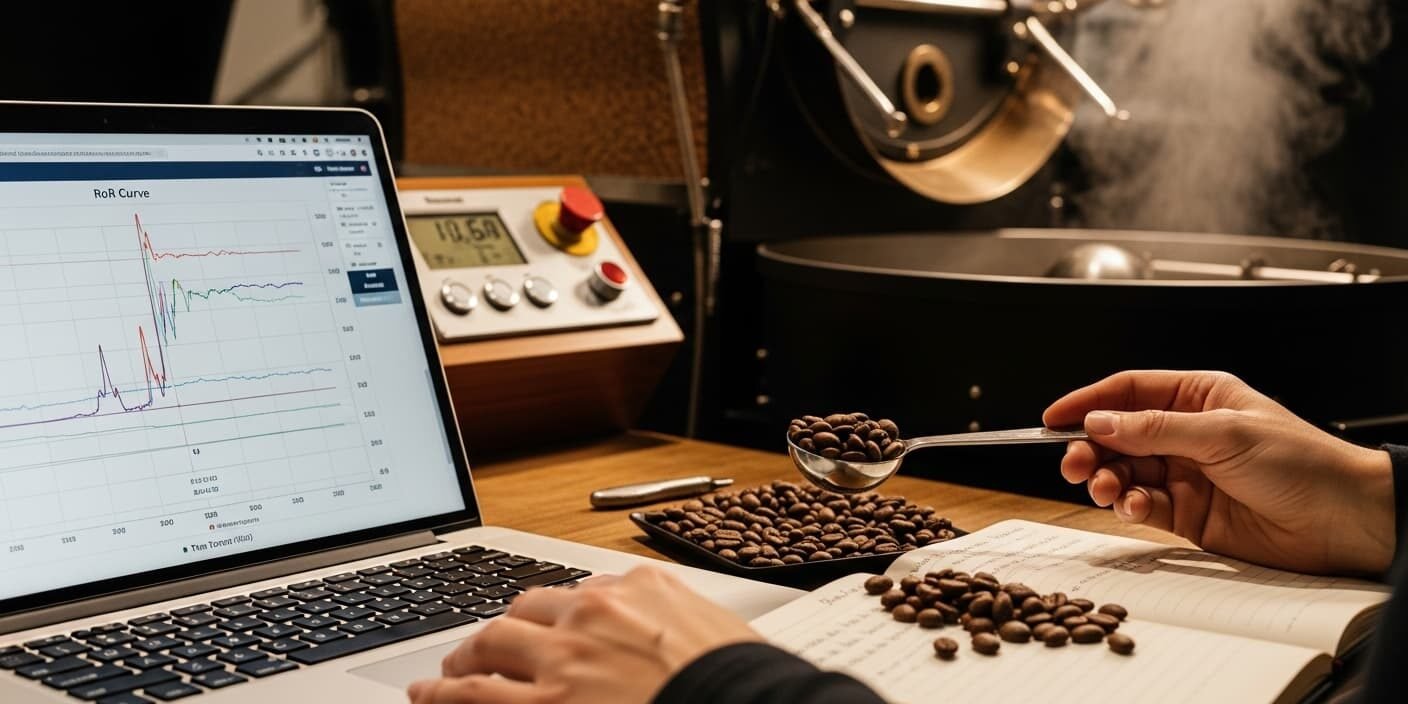
The first time I saw a roasting curve on a screen—with its smooth temperature line rising and the RoR line moving like an electrocardiogram—it felt intimidating. It seemed like territory reserved exclusively for professional roasters with years of experience. But over time I understood that reading the curve and the Rate of Rise is, fundamentally, learning to listen to what the coffee is telling you while it roasts: whether it is going too fast, whether it is stalling, whether the development after first crack is sufficient.
I have researched the fundamentals of the roasting curve, what exactly the RoR is and why it matters, how to interpret the key phases of the process, and how to turn all of this into better cup profiles. I hope this article helps you see those curves with different eyes. Let’s begin!
What the roasting curve is and what information it contains
The roasting curve is a graphical representation of how the temperature of the coffee bean changes over time during the roasting process. The horizontal axis is time (minutes), and the vertical axis is temperature (°C). Normally, several lines are recorded simultaneously: the bean temperature (Bean Temperature or BT), the temperature of the drum environment (Environment Temperature or ET), and the derivative of bean temperature over time, which is the RoR. The bean temperature curve has a characteristic shape: it starts by dropping slightly from the charge temperature (the inflection point or ‘turning point,’ where the cooler bean absorbs heat from the drum and the probe starts to rise), then rises progressively, accelerates toward first crack, and continues developing until discharge. The shape of this curve—its slope, its smoothness or abruptness, its changes in direction—contains all the information about how heat has been applied and how the bean has responded.
The Rate of Rise (RoR): definition, calculation, and importance
The Rate of Rise (RoR) is the speed at which the bean temperature increases, expressed in degrees per minute (°C/min or °F/min). If the bean was at 150°C a minute ago and is now at 158°C, the RoR is 8°C/min. The RoR is not a measure of absolute temperature but of the rate of change, and that makes it especially useful: it tells you not where the bean is in temperature terms, but how fast it is getting there. A high RoR means the bean is absorbing a lot of heat quickly; a low or declining RoR indicates that the rate of heat absorption is decreasing. In a well-executed roast, the RoR tends to decline smoothly and in a controlled way throughout the process—it is what roasters call an ‘RoR drop’ or declining RoR. An RoR that suddenly rises indicates excessive heat input; an RoR that falls too quickly (or worse, rises from a very low point) signals loss of control and the risk of a flat or ‘baked’ roast.
The phases of roasting on the curve
Roasting is conventionally divided into three phases. The drying phase (from charge to approximately 150°C): the bean releases moisture and absorbs heat without major visible chemical changes; the RoR is usually high at first and begins to decline. The Maillard or browning phase (approximately 150–196°C): the Maillard reactions begin, generating the more complex flavor and color compounds; the RoR should remain within a controlled range, typically between 8 and 15°C/min in conventional drum roasters. The development phase (from first crack, usually around 196–205°C, to discharge): this is the most critical phase and normally the shortest; the RoR is usually the lowest of the entire process (between 3 and 8°C/min) and should be especially stable; here the roaster decides the level of development—how much time and temperature after first crack—which will determine the DTR (Development Time Ratio) and with it the coffee’s final character. An RoR that rises during development is a warning sign: it can cause an uneven roast or surface scorching.
Curve and RoR adjustments according to the desired flavor profile
For light-roasted coffees intended for filter brewing with a fruity profile and bright acidity, a longer curve with a moderate RoR and a well-developed Maillard phase is generally sought, along with a shorter development time (8–12% of the total time). For medium-dark roasted coffees with more body and sweetness, the curves are usually somewhat shorter, with a higher RoR in the Maillard phase and a somewhat longer development time. An RoR that is too high during Maillard can produce a coffee with excessive acidity and an astringent flavor (‘underdeveloped’); an RoR that is too low or stalled can produce ‘baked’ coffee—flat, without acidity or complexity, with bread or cardboard notes. Charge temperature is also crucial: if it is too high, the bean can scorch on the surface before developing inside; if it is too low, the curve begins with too little momentum and is harder to control.
Tools for recording and analyzing curves
Roast logging software—Artisan (free and open source), Cropster (paid professional software), or RoasTime (specific to Aillio)—connects the roaster’s temperature sensors to a computer and draws the curve in real time while the roast takes place. The accuracy of the data depends on the location and type of probes: thermocouple probes in contact with the bean inside the drum are the most reliable; those located in the airflow are faster but less representative of the bean’s actual temperature. For home roasters (Gene Café, Behmor, Fresh Roast), monitoring options are more limited, but even an infrared thermometer and manual temperature logging every 30 seconds lets you begin to understand the dynamics of the curve. Systematic cupping correlated with the recorded curves—what flavor came out with what curve shape—is the most effective way to learn how to interpret and adjust.
Frequently asked questions about the roasting curve and the Rate of Rise
What exactly is the Rate of Rise and how does it influence the roast?
The RoR is the rate at which the bean temperature rises, expressed in degrees per minute. It directly influences the sensory profile: a high RoR during Maillard generates more acidity and liveliness; a low and controlled RoR promotes more sweetness and body. In general, the goal is an RoR that declines smoothly and progressively throughout the roast, without sudden spikes or stalls.
How does charge temperature affect the roast?
Charge temperature (the temperature of the drum at the moment the green coffee is introduced) determines the initial energy the bean receives. A charge that is too high can thermally ‘shock’ the bean, generating excessive surface heat; one that is too low can lead to a drying phase that is too slow, making later control more difficult. Optimal ranges vary depending on the roaster and the batch size, but they are typically between 170 and 220°C for conventional drum roasters.
When is the best time to adjust the RoR?
Heat adjustments (gas or electricity depending on the roaster) affect the RoR with a delay of 30–60 seconds, so anticipation is key. The most critical moment, when the roaster must be especially attentive and make fine adjustments, is the transition between the Maillard phase and first crack: any excess heat at that point can send the RoR up during development and compromise the result. During development, the most common approach is to reduce or maintain the heat to achieve that low and stable RoR.
Which sensors are the most reliable for measuring temperature?
Type K thermocouple probes located inside the drum in direct contact with the bean mass are the most representative of the bean’s actual temperature. Probes in the airflow (ET) react more quickly to changes in heat but reflect the environment, not the bean. Most professional roasters have both; using the two in a complementary way gives the most complete picture of the process.
Is it possible to control the curve and the RoR at home?
Yes, with limitations. The most popular home roasters (Fresh Roast SR800, Gene Café, Behmor) have more limited temperature and time control than professional machines, but you can connect an external thermocouple and use Artisan to record the curve. Even without software, writing down the temperature every 30–60 seconds during the roast and correlating it with the cupping result is enough to start understanding the dynamics and make progressive improvements.
How do you interpret the curve to avoid burnt or flat coffee?
‘Baked’ or flat coffee occurs when the RoR drops too quickly or stalls during the Maillard phase: the bean has received enough heat to darken, but not enough to develop the flavor compounds properly. The sign on the curve is an RoR that flattens or rises from a very low point in the development phase. Burnt coffee appears when the RoR rises during development or the final temperature is too high for the level of development achieved. In both cases, systematic cupping is the only way to confirm the diagnosis and adjust the profile.
I hope this guide to the roasting curve and the RoR has given you the keys to start reading and understanding what happens inside the drum in much greater depth. At Coffee Sapiens we never stop researching and learning about the wonderful world of coffee, so stay tuned because I’ll keep posting new content on the blog soon. Thanks for being there, Coffee Lover!
{ “@context”: “https://schema.org”, “@type”: “FAQPage”, “mainEntity”: [ { “@type”: “Question”, “name”: “What exactly is the Rate of Rise and how does it influence the roast?”, “acceptedAnswer”: { “@type”: “Answer”, “text”: “The RoR is the rate at which the bean temperature rises in degrees per minute. A high RoR during Maillard generates more acidity; a low RoR promotes sweetness and body. The goal is an RoR that declines smoothly and progressively, without sudden spikes or stalls.” } }, { “@type”: “Question”, “name”: “How does charge temperature affect the roast?”, “acceptedAnswer”: { “@type”: “Answer”, “text”: “Charge temperature determines the initial energy the bean receives. If it is too high, it can generate excessive surface heat; if it is too low, it makes later control more difficult. Typically between 170 and 220°C for conventional drum roasters.” } }, { “@type”: “Question”, “name”: “When is the best time to adjust the RoR?”, “acceptedAnswer”: { “@type”: “Answer”, “text”: “Adjustments affect the RoR with a delay of 30–60 seconds, so anticipation is key. The most critical moment is the transition between the Maillard phase and first crack.” } }, { “@type”: “Question”, “name”: “Which sensors are the most reliable for measuring temperature?”, “acceptedAnswer”: { “@type”: “Answer”, “text”: “Type K thermocouple probes inside the drum, in contact with the bean mass, are the most representative. Probes in the airflow react faster but reflect the environment, not the bean.” } }, { “@type”: “Question”, “name”: “Is it possible to control the curve and the RoR at home?”, “acceptedAnswer”: { “@type”: “Answer”, “text”: “Yes, with limitations. An external thermocouple can be connected to home roasters and Artisan can be used to record the curve. Logging the temperature periodically and correlating it with cupping helps to understand the dynamics.” } }, { “@type”: “Question”, “name”: “How do you interpret the curve to avoid burnt or flat coffee?”, “acceptedAnswer”: { “@type”: “Answer”, “text”: “‘Baked’ coffee appears when the RoR drops too quickly in the Maillard phase. Burnt coffee appears when the RoR rises during development or the final temperature is excessive. Systematic cupping confirms the diagnosis.” } } ] }

Soy Javier Romero, especialista en Marketing Digital, Coffee Lover y redactor de Coffee Sapiens.
Bienvenidos a Coffee Sapiens. Somos un medio digital independiente dedicado a la divulgación, análisis y cultura del café.