
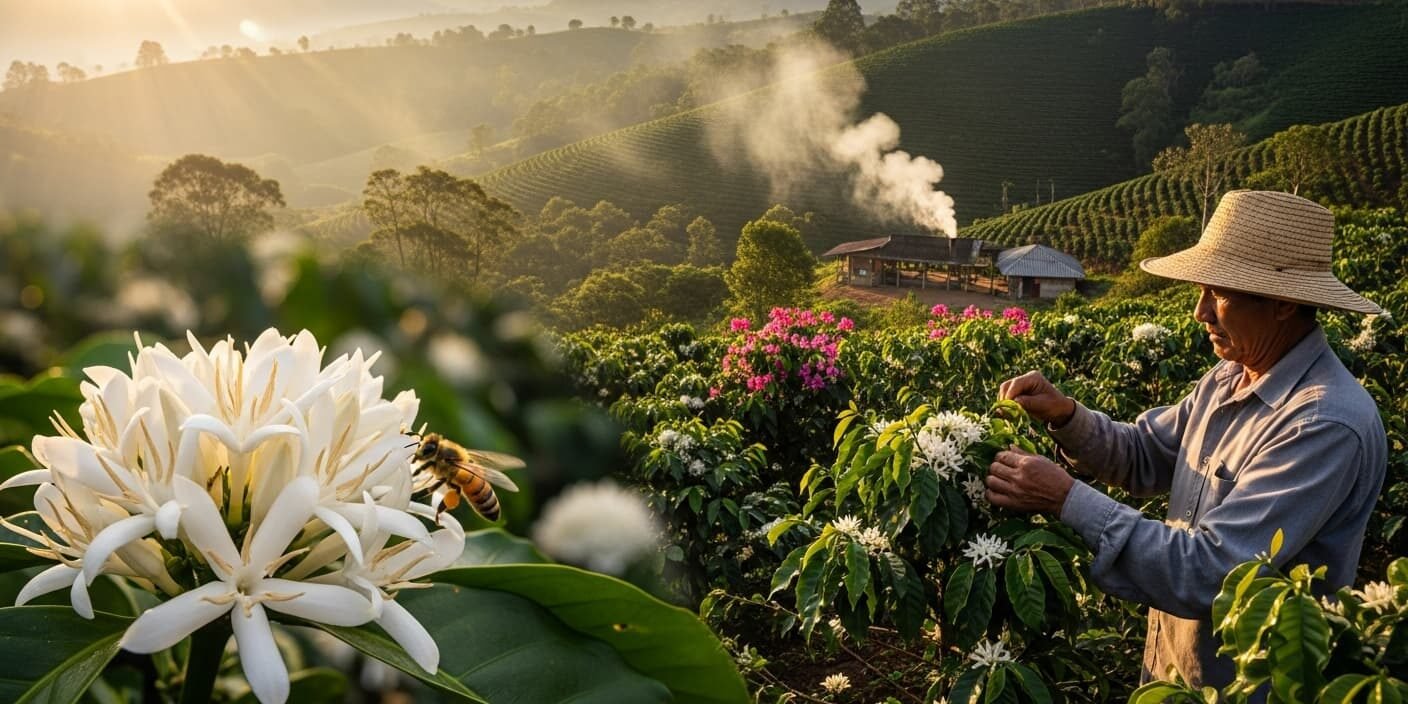
It had always seemed obvious to me that bees and coffee were connected, but I hadn’t looked into just how close that relationship is until I started researching for this article. I discovered that the caffeine in coffee flower nectar not only attracts bees, but also improves their olfactory memory—it literally makes them better pollinators. And that honey produced in coffee plantations has a unique aromatic profile. In this article, I’ll tell you all about the fascinating symbiosis between coffee and beekeeping. Let’s begin!
Coffee plant flowering: cycles and conditions
The coffee plant usually blooms twice a year in most producing regions, with the first flowers appearing between March and April and a second flowering between September and October. Flowering is triggered mainly by rainfall after a dry period—the coffee flowers remain open for only 2-3 days, so synchrony with pollinators is critical. Ideal conditions are mild temperatures, adequate humidity, and rainfall that breaks the previous dry spell.
Why caffeine in nectar makes bees better pollinators
The nectar of coffee plant flowers contains small amounts of caffeine. Studies from Newcastle University showed that caffeine improves bees’ olfactory memory: bees exposed to caffeinated nectar remember the scent of that flower better and return to it more often. This mechanism—which benefits the plant by ensuring more efficient pollination—is a fascinating example of coevolution between plant and pollinator.
Impact of pollination on bean quality
Although Coffea arabica is self-fertile (it can pollinate itself), cross-pollination by bees improves both yield and bean quality. Field studies have shown that coffee plantations with an active bee presence produce up to 20% more fruit, with greater size uniformity, which translates into a more complex organoleptic profile and better cupping scores.
Coffee blossom honey: a unique product
Honey produced by bees that forage mainly on coffee flowers has a distinctive aromatic profile: light amber to golden color, delicate floral notes—reminiscent of the characteristic jasmine scent of coffee blossoms—and a gentle sweetness with a slightly spicy aftertaste. It is a niche product with considerable added value in premium markets, especially in regions such as Hawaii, Jamaica, or certain areas of Colombia and Ethiopia where beekeeping in coffee plantations is well established.
Economic benefits and sustainability of integrating beekeeping into coffee plantations
Keeping hives in coffee plantations is an agricultural diversification model with a very favorable cost-benefit ratio. A well-managed hive can produce between 40 and 50 kg of honey per year, generating additional income that reduces dependence on a single crop. In addition, the presence of bees improves coffee yields, creating a mutually beneficial synergy. Climate change threatens this symbiosis: shifts in rainfall patterns can desynchronize the flowering of the coffee plant from bees’ active cycles, underscoring the importance of conserving surrounding forests and maintaining local biodiversity.
Frequently asked questions about coffee, honey, and pollination
Do coffee flowers have a special aroma?
Yes, and it is one of the most intense and pleasant aromas of any agricultural plant. Coffee flowers give off a fragrance very similar to jasmine, sweet and penetrating. Although they only remain open for 2-3 days, during that time the scent can permeate an entire farm. Coffee growers who have witnessed a massive flowering often describe it as one of the most memorable experiences in coffee cultivation.
Does the caffeine in nectar affect bees negatively?
Studies indicate that the concentrations of caffeine in coffee flower nectar are low enough not to be toxic to bees, but high enough to improve their olfactory memory. It is a very precise evolutionary balance. At higher (artificial) concentrations, caffeine can negatively affect bee behavior, but that does not happen under natural conditions.
Where can I get coffee blossom honey?
Coffee blossom honey is a niche product with limited distribution. The best options are stores specializing in artisanal honeys, importers of gourmet products, or directly through coffee farms that also produce honey. In Spain, some delicatessen shops import coffee blossom honey of Hawaiian or Colombian origin. You can also find it at organic farming fairs and specialized markets.
How many bees are needed per hectare of coffee plantation?
The general recommendation is 1-2 hives per hectare of coffee plantation during the flowering period. An active hive can contain between 20,000 and 60,000 bees, which is enough to cover a pollination radius of several hundred meters. Some studies recommend placing hives less than 500 meters from coffee plantations to maximize pollination efficiency.
Can coffee and honey be combined in the cup?
Absolutely, and it is a combination with a long tradition. Coffee blossom honey in Ethiopian or Central American coffee is especially interesting because it reinforces the floral notes of the coffee without adding artificial sweetness. The recommendation is to use honey with delicate profiles—acacia, orange blossom, or coffee blossom honey itself—and add it when the coffee is around 70-75 °C so as not to destroy its enzymes and aromatic compounds.
At Coffee Sapiens, we never stop researching to bring you the most fascinating connections in the world of coffee, from the bean to the ecosystem that surrounds it. The relationship between bees and the coffee plant is one of those stories that deserves to be told. Thanks for being there, Coffee Lover!
{ “@context”: “https://schema.org”, “@type”: “FAQPage”, “mainEntity”: [ { “@type”: “Question”, “name”: “Do coffee flowers have a special aroma?”, “acceptedAnswer”: { “@type”: “Answer”, “text”: “Yes, coffee flowers give off a fragrance very similar to jasmine, sweet and penetrating. They only remain open 2-3 days, but during that time the scent can permeate an entire farm. Coffee growers describe it as one of the most memorable experiences in cultivation.” } }, { “@type”: “Question”, “name”: “Does the caffeine in nectar affect bees negatively?”, “acceptedAnswer”: { “@type”: “Answer”, “text”: “Not under natural conditions. The concentrations of caffeine in coffee flower nectar are low and benefit bees’ olfactory memory without being toxic. It is a very precise evolutionary balance that benefits both the bees and the plant.” } }, { “@type”: “Question”, “name”: “Where can I get coffee blossom honey?”, “acceptedAnswer”: { “@type”: “Answer”, “text”: “Coffee blossom honey is a niche product. The best options are stores specializing in artisanal honeys, importers of gourmet products, or directly through coffee farms. In Spain, some delicatessen shops import Hawaiian or Colombian coffee blossom honey.” } }, { “@type”: “Question”, “name”: “How many bees are needed per hectare of coffee plantation?”, “acceptedAnswer”: { “@type”: “Answer”, “text”: “The general recommendation is 1-2 hives per hectare during flowering. An active hive contains between 20,000 and 60,000 bees, enough to cover several hundred meters. It is recommended to place hives less than 500 meters from coffee plantations.” } }, { “@type”: “Question”, “name”: “Can coffee and honey be combined in the cup?”, “acceptedAnswer”: { “@type”: “Answer”, “text”: “Yes, it is a combination with a long tradition. Coffee blossom honey in Ethiopian coffee reinforces floral notes without artificial sweetness. It is recommended to add it when the coffee is at 70-75 °C to preserve its enzymes and aromatic compounds.” } } ] }

Soy Javier Romero, especialista en Marketing Digital, Coffee Lover y redactor de Coffee Sapiens.
Bienvenidos a Coffee Sapiens. Somos un medio digital independiente dedicado a la divulgación, análisis y cultura del café.