
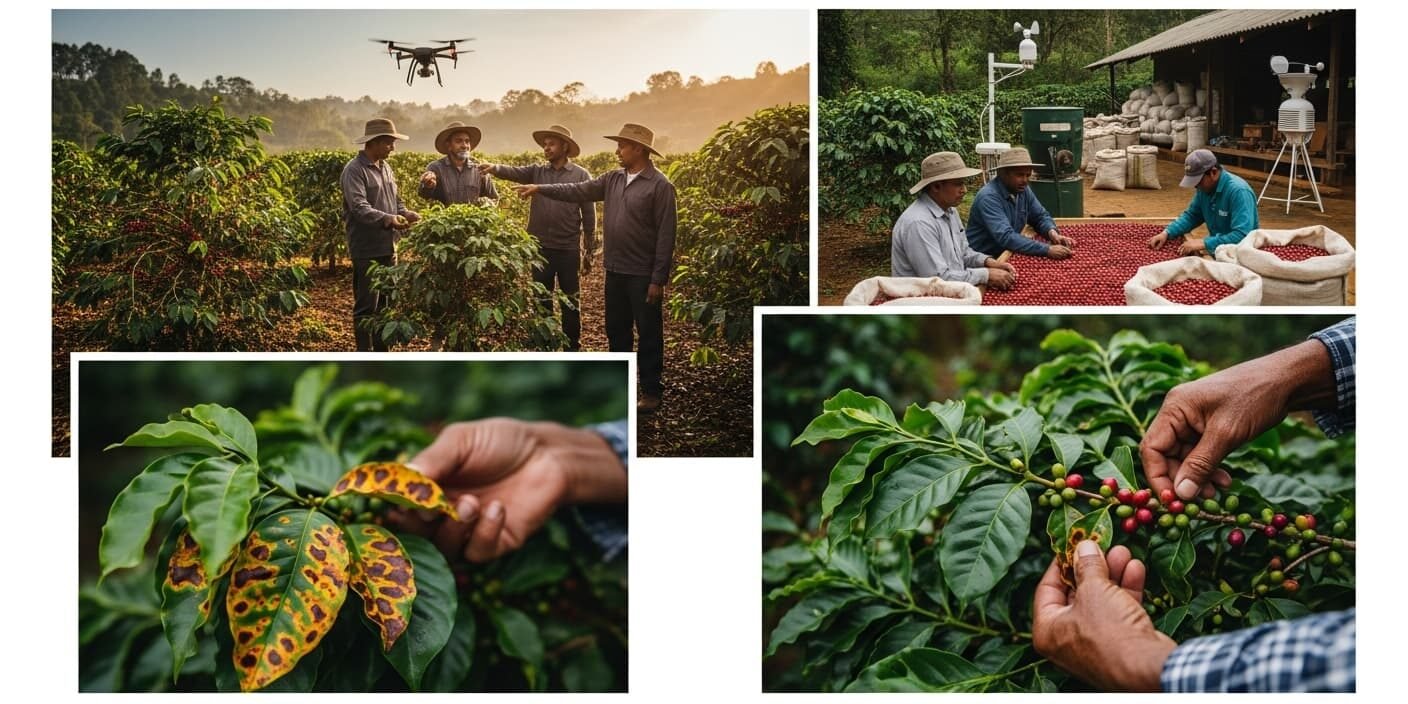
While studying the history of coffee, I came across one of the most dramatic episodes in global coffee farming: the rust that devastated Ceylon’s plantations in the 19th century and turned the island, which had been one of the world’s great coffee-producing powers, into what we now know mainly as a tea-exporting country. The story is fascinating and offers direct lessons for today’s coffee farming, which continues to face this same disease in Latin America, Africa, and Asia. I researched its history, causes, and the solutions being applied today in depth. Let’s begin!
Impact of coffee leaf rust on Ceylon’s coffee production
Coffee leaf rust, a devastating fungal disease caused by the fungus Hemileia vastatrix, was first identified in Ceylon in 1869. From then on, its spread was relentless: in less than two decades it wiped out almost all of the island’s plantations. In Ceylon, the fungus found the perfect conditions for its expansion: large-scale monocultures of Coffea arabica, with no genetic diversity or natural containment barriers. The arrival of rust forced coffee growers to adopt fungicides and phytosanitary techniques, but they were not effective enough to stop the epidemic, and most coffee farms ended up being converted into tea plantations. The economic and social consequences were devastating: enormous financial losses, lower quality in the affected beans that hurt their market value, farms lost or completely converted, and migration of rural workers to the cities that weakened the social and cultural ties built around coffee cultivation.
What favored the spread of the fungus
A combination of climatic and agricultural factors explains the virulence of the epidemic. High humidity together with warm temperatures creates the ideal environment for rust to grow: these conditions promote the production of spores that spread easily between plants, and Ceylon’s humid tropical climate proved to be the perfect setting for its expansion. Heavy rains, common in certain seasons, increased the buildup of moisture on the foliage, coinciding with the periods of greatest fungal activity. In terms of farming practices, arabica monocultures without genetic diversity were the key factor behind Ceylon’s vulnerability—something that modern techniques such as integrated pest management, variety diversification, and agroforestry systems seek to correct today. Poor soil management and lack of pest control also worsen the situation when sustainable farming practices are not applied.
Current prevention and control methods
Genetic research has made it possible to develop coffee varieties with greater resistance to rust: Castillo, Catimor, and Sarchimor, created by crossing arabica with robusta or with Timor hybrids, offer natural resistance to the fungus without completely sacrificing cup quality, and their adoption on farms around the world has proven effective in increasing the long-term viability of harvests. The responsible use of fungicides—with proper product selection and application at key moments in the disease cycle—helps minimize its spread without creating resistance or contaminating the environment. Pruning and canopy management techniques improve air circulation and sunlight exposure, reducing internal moisture levels in the coffee plantation and creating an environment less favorable to the fungus.
Frequently asked questions about coffee leaf rust in Ceylon
Why did rust wipe out coffee in Ceylon and not in other countries?
Ceylon’s collapse was so complete because the island had extensive monocultures of a single arabica variety with no genetic diversity. When rust arrived in 1869, the fungus found millions of equally susceptible plants with no resistance barrier. In other countries with greater varietal diversity or with better geographic isolation conditions, the spread was slower and more manageable.
How does rust affect coffee cup quality?
Rust weakens plants by attacking the leaves, reducing their photosynthetic capacity. A weakened plant produces beans that do not reach their full ripening potential, resulting in lower weight, incomplete sugars, and a less complex and aromatic flavor profile. Affected lots show defects, lower density, and lower cupping scores.
What can growers do to protect their crops?
The most effective strategies are: adopting rust-resistant varieties (Castillo, Catimor, Sarchimor), implementing cultivation techniques that improve canopy aeration, applying fungicides preventively during periods of greatest risk, regularly monitoring plant conditions, and diversifying with agroforestry systems that regulate humidity and temperature within the coffee plantation.
Is coffee leaf rust still a problem today?
Yes, it is one of the biggest challenges in global coffee farming. Between 2012 and 2015, a severe rust epidemic affected Central America, causing production losses of more than 50% in some countries such as Honduras and Guatemala. Climate change is expanding the geographic areas and times of year favorable to the fungus, making research into resistant varieties more urgent than ever.
Why did Ceylon become a tea producer after rust?
After the coffee collapse of the late 19th century, British colonizers looked for a profitable alternative crop for the land that had already been cleared. Tea proved to be a viable option for the island’s altitudes and climate. The transition was massive and relatively quick: in just a few decades, Ceylon (now Sri Lanka) went from being one of the world’s largest coffee exporters to becoming one of the leading tea producers.
At Coffee Sapiens, we never stop researching to bring you the most fascinating episodes and the most relevant lessons from coffee history. The Ceylon rust crisis is one of those chapters that changed the world. Thanks for being here, Coffee Lover!
{ “@context”: “https://schema.org”, “@type”: “FAQPage”, “mainEntity”: [ { “@type”: “Question”, “name”: “Why did rust wipe out coffee in Ceylon and not in other countries?”, “acceptedAnswer”: { “@type”: “Answer”, “text”: “The collapse was total because the island had extensive monocultures of a single variety with no genetic diversity. The fungus found millions of equally susceptible plants with no resistance barrier.” } }, { “@type”: “Question”, “name”: “How does rust affect coffee cup quality?”, “acceptedAnswer”: { “@type”: “Answer”, “text”: “It weakens the plants by reducing their photosynthetic capacity, producing beans with incomplete sugars and a less complex flavor profile, with lower density and lower cupping scores.” } }, { “@type”: “Question”, “name”: “What can growers do to protect their crops?”, “acceptedAnswer”: { “@type”: “Answer”, “text”: “Adopt resistant varieties (Castillo, Catimor, Sarchimor), improve canopy aeration, apply fungicides preventively, and diversify with agroforestry systems that regulate humidity.” } }, { “@type”: “Question”, “name”: “Is coffee leaf rust still a problem today?”, “acceptedAnswer”: { “@type”: “Answer”, “text”: “Yes. Between 2012 and 2015, a severe epidemic affected Central America with losses of more than 50% in some countries. Climate change is expanding the areas and periods favorable to the fungus.” } }, { “@type”: “Question”, “name”: “Why did Ceylon become a tea producer after rust?”, “acceptedAnswer”: { “@type”: “Answer”, “text”: “British colonizers converted the land to tea, which was viable for the island’s climate. In a few decades, Ceylon went from being a major coffee exporter to a leading tea producer.” } } ] }

Soy Javier Romero, especialista en Marketing Digital, Coffee Lover y redactor de Coffee Sapiens.
Bienvenidos a Coffee Sapiens. Somos un medio digital independiente dedicado a la divulgación, análisis y cultura del café.